Daily Life in Nazareth: The Village That Raised a Savior
Life in First Century Judeac. 4 BC – 30 AD

Daily Life in Nazareth: The Village That Raised a Savior

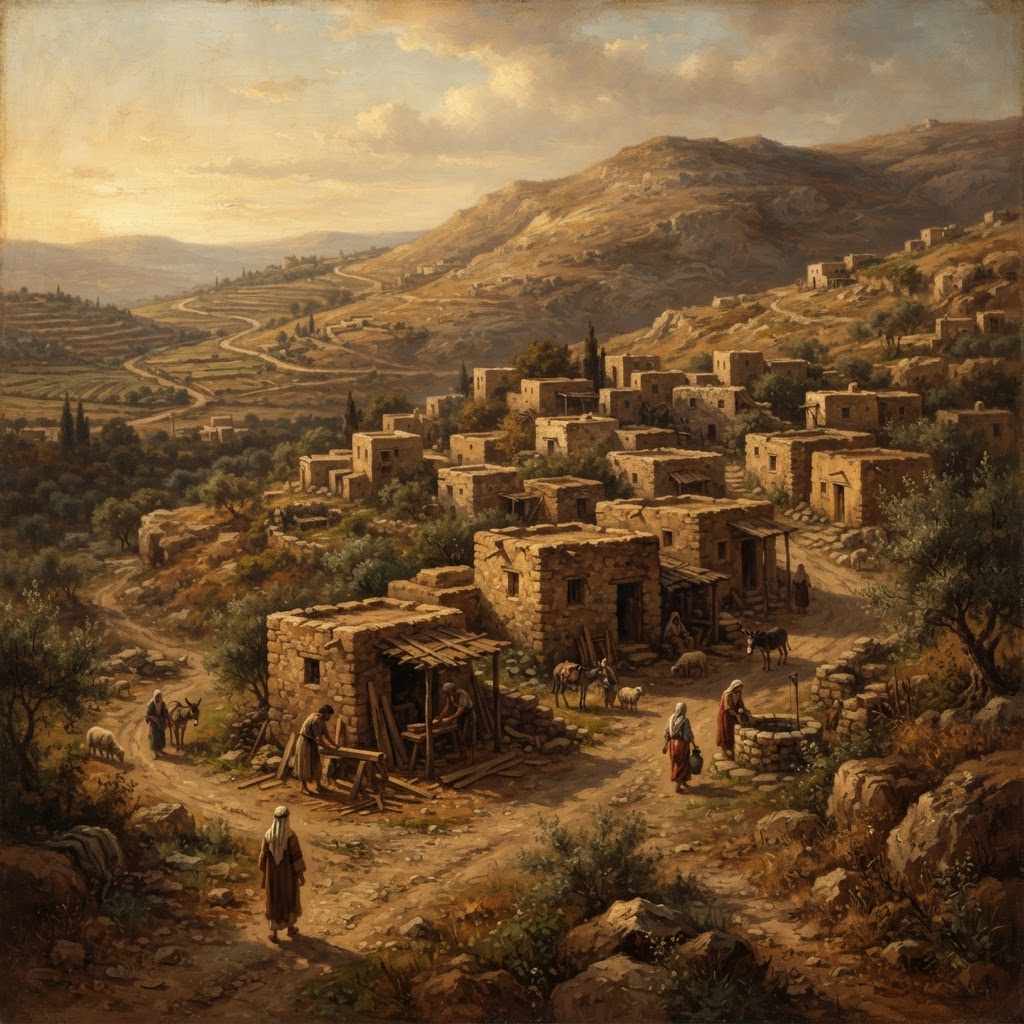
Nazareth was a tiny village of perhaps 200 people — yet it was here that the Son of God grew up, learned a trade, and prepared for His ministry.

5 min read
Share

The Biblical Account

When the angel Gabriel appeared to Mary, she was in Nazareth, a village so insignificant that it is never mentioned in the Old Testament, the Talmud, or by the historian Josephus outside of Gospel references. After Jesus' birth in Bethlehem and the family's flight to Egypt, they returned and settled in Nazareth, where Jesus 'grew and became strong, filled with wisdom' (Luke 2:40).

At twelve, Jesus was found in the temple courts, amazing the teachers with His understanding. But then Luke gives us a quiet, profound verse: 'And he went down with them and came to Nazareth and was submissive to them' (Luke 2:51). The Son of God spent roughly thirty years in obscurity, in a small village, learning carpentry from Joseph. He was so identified with this town that He was called 'Jesus of Nazareth,' and Nathanael famously asked, 'Can anything good come out of Nazareth?' (John 1:46).

The World at That Time

First-century Nazareth was a small agricultural village, likely home to only 150-200 people. It sat on a hillside in the region of Galilee, about 65 miles north of Jerusalem. The village had a single synagogue, a few dozen homes, and was surrounded by terraced farmland. Most residents were farmers, shepherds, or craftsmen. Life was simple and rhythmic, governed by the agricultural calendar and Jewish religious festivals.

A carpenter (Greek: tekton) in this context was more than a woodworker — the word means 'craftsman' or 'builder.' In a stone-rich region like Galilee, a tekton worked with stone, wood, and other materials, building homes, furniture, and agricultural tools. Jesus likely worked on the nearby Roman city of Sepphoris, which Herod Antipas was rebuilding just a few miles from Nazareth.

Religious life centered on the synagogue, where the community gathered on the Sabbath for prayer, Scripture reading, and teaching. Education for boys began around age 5-6, learning to read Hebrew from the Torah. The diet was simple: bread, olive oil, fish from the nearby Sea of Galilee, lentils, figs, grapes, and occasionally meat during festivals.

Faith Reflection

There is something deeply beautiful about the hidden years. The One who spoke galaxies into existence spent three decades learning to build tables. God chose not a palace but a carpenter's shop, not a famous city but an overlooked village, not the centers of power but the margins of society.

This tells us something about how God works. He values faithfulness in obscurity. The years of quiet obedience in Nazareth were not wasted time — they were preparation. Jesus learned the rhythms of work, the rhythm of Sabbath, the rhythms of community. When He later spoke of the Father's house, of building on rock, of bearing fruit, these metaphors flowed from hands that had shaped real materials.

For us, the hidden years are often where character is formed. Faithfulness in small things — in our work, our homes, our ordinary days — is not a delay in God's plan. It is the plan.

Scripture Reference

Luke 2:39-52; Matthew 13:54-58

“Your word is a lamp to my feet and a light to my path.” — Psalm 119:105