The Thunder on the Mountain: Sinai and the Law
The Exodusc. 1446 BC

The Thunder on the Mountain: Sinai and the Law

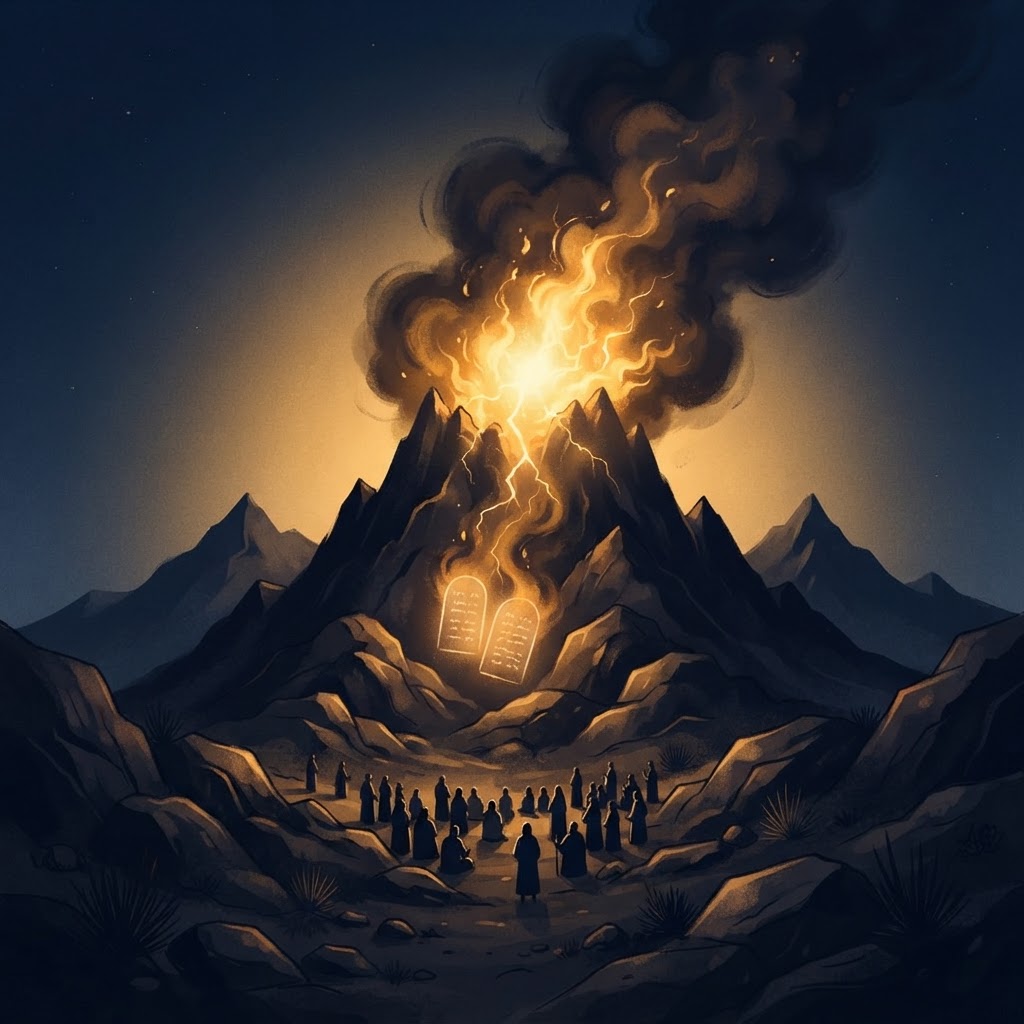
At Mount Sinai, God descended in fire and smoke to give Israel the Law — a covenant that would shape their identity for centuries.

6 min read
Share

The Biblical Account

Three months after leaving Egypt, Israel arrived at Mount Sinai. God told Moses to consecrate the people: 'On the third day the LORD will come down on Mount Sinai in the sight of all the people' (Exodus 19:11). On the morning of the third day, there were thunder and lightning, a thick cloud on the mountain, and a very loud trumpet blast. The mountain was wrapped in smoke because the Lord descended on it in fire. The whole mountain trembled violently.

In this fearsome setting, God gave the Ten Commandments — the moral foundation of Israel's covenant with Him. Then Moses went up the mountain to receive the rest of the Law: civil laws, ceremonial laws, and instructions for building the Tabernacle. The people, terrified, said to Moses, 'You speak to us, and we will listen; but do not let God speak to us, lest we die' (Exodus 20:19).

While Moses was on the mountain receiving the covenant, the people below were already breaking it — crafting a golden calf to worship. This heartbreaking scene revealed how quickly the human heart turns from God, even after witnessing His power.

The World at That Time

Mount Sinai's exact location is debated. The traditional site is Jebel Musa in the Sinai Peninsula, where St. Catherine's Monastery has stood since the 6th century AD. Some scholars propose a site in northwestern Saudi Arabia (Jebel al-Lawz), which more closely matches biblical descriptions of a mountain with a blackened peak.

In the ancient Near East, mountains were considered sacred spaces — meeting points between heaven and earth. Gods were believed to dwell on high places. The thunder, lightning, fire, and earthquake at Sinai would have been immediately understood by ancient peoples as divine theophany — a god manifesting his power.

The covenant God made with Israel at Sinai followed a structure remarkably similar to ancient Near Eastern suzerain-vassal treaties: a preamble identifying the suzerain, a historical prologue, general stipulations, specific stipulations, blessings and curses, and witness provisions. This form would have been immediately recognizable to Israel.

Faith Reflection

At Sinai, God revealed both His holiness and His desire for relationship. The thunder and fire proclaimed that this God is not to be approached casually — He is holy, set apart, utterly unlike anything in creation. Yet He was also making a covenant with a group of former slaves, telling them they would be His 'treasured possession' among all peoples.

The contrast between the giving of the Law and the golden calf is the story of every human heart. We want God's promises but not His requirements. We want His rescue but not His rule. The Law at Sinai was never meant to save — it was meant to show us our need for a Savior. Paul wrote, 'The law was our guardian until Christ came' (Galatians 3:24).

Scripture Reference

Exodus 19–20, 32

“Your word is a lamp to my feet and a light to my path.” — Psalm 119:105