The Roads of Rome: Highways for the Gospel
The Early Churchc. 46-62 AD

The Roads of Rome: Highways for the Gospel

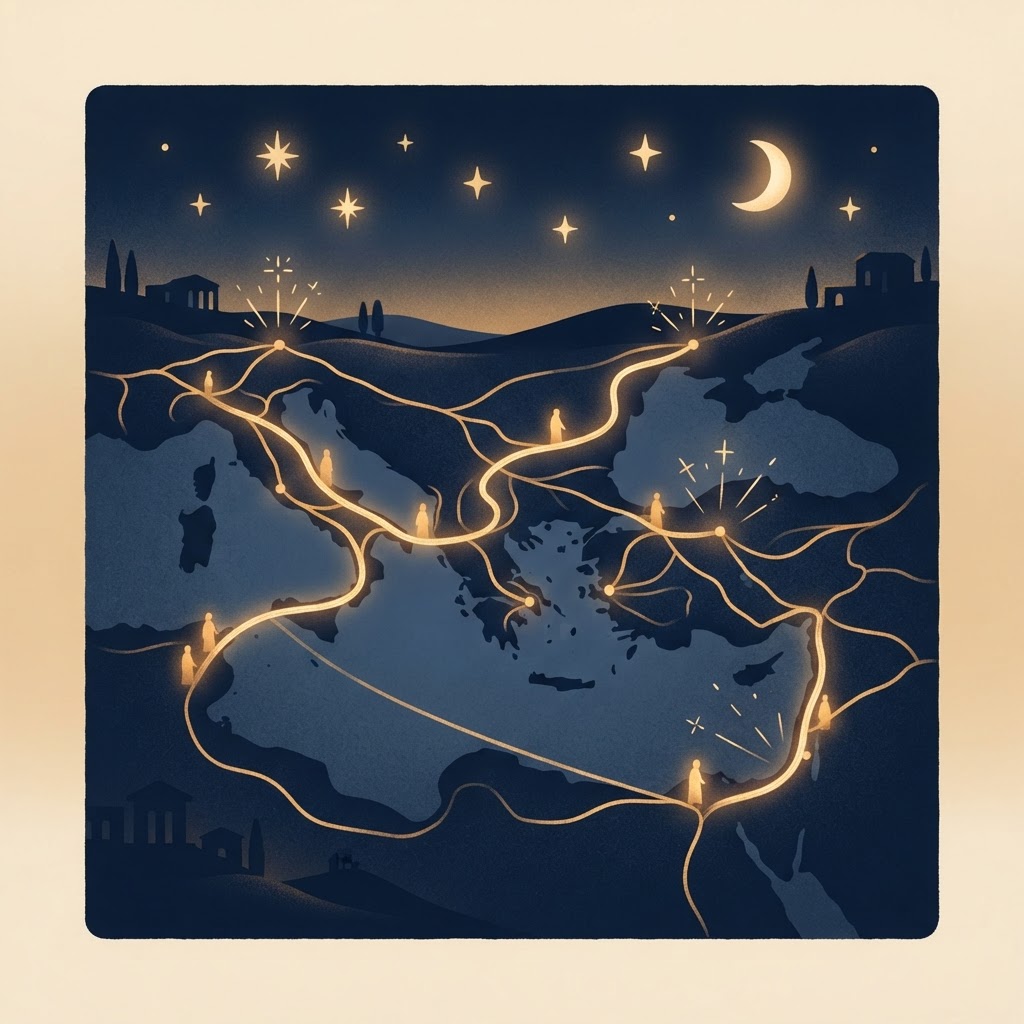
The Roman Empire built an unprecedented road network — unknowingly creating the perfect infrastructure for the spread of the gospel.

6 min read
Share

The Biblical Account

Jesus' final command was to 'go and make disciples of all nations' (Matthew 28:19). He told His disciples, 'You will be my witnesses in Jerusalem and in all Judea and Samaria, and to the end of the earth' (Acts 1:8). The Book of Acts chronicles this expansion — from Jerusalem to Judea to Samaria to the Gentile world, culminating in Paul reaching Rome itself.

Paul's missionary journeys covered thousands of miles. His first journey took him through Cyprus and Galatia (Acts 13-14). His second journey brought him into Macedonia and Greece — Philippi, Thessalonica, Berea, Athens, Corinth (Acts 15-18). His third journey revisited many of these cities and spent over two years in Ephesus (Acts 18-21). Finally, as a prisoner, Paul was transported to Rome, where he preached 'with all boldness and without hindrance' (Acts 28:31).

Paul's letters — Romans, Corinthians, Galatians, Ephesians, Philippians, Colossians, Thessalonians — were addressed to churches planted along these very routes. The gospel traveled not by divine teleportation but by ordinary people walking ordinary roads.

The World at That Time

The Romans built approximately 250,000 miles of roads across their empire, of which about 50,000 miles were stone-paved. The most famous, the Via Appia (Appian Way), connected Rome to the south of Italy. The Via Egnatia crossed the Balkans, linking the Adriatic to the Aegean — Paul likely traveled this road from Neapolis to Philippi and Thessalonica. Roads connected major cities, ports, and military installations, facilitating trade, military movement, and communication.

Roman roads were engineering marvels. They were built with multiple layers: a foundation of compacted earth, then gravel and sand, then flat stone paving stones. They were crowned for drainage, had milestones every Roman mile (about 1,620 yards), and some included way stations for rest and fresh horses.

This infrastructure was not built for the gospel — it was built for Roman military and commercial dominance. Yet God, in His sovereignty, used the very roads Rome built to conquer the known world as highways for the message of Christ. The Pax Romana (Roman Peace) also reduced piracy at sea and banditry on roads, making travel safer for early missionaries like Paul.

Faith Reflection

God often uses what others built for entirely different purposes to accomplish His will. The Romans built roads for conquest and commerce. God used them for grace. The cross — Rome's instrument of execution — became the very symbol of salvation.

This should give us hope. The institutions, the infrastructure, the culture of our world may not be designed for God's purposes — but God is never thwarted. He works through what exists, turning human ambition into divine opportunity.

Paul didn't wait for ideal conditions. He walked the roads that were there. He used the common language (Greek) that connected the empire. He sailed on Roman ships and appealed to Roman citizenship for protection. He didn't fight the system — he used it to spread the message of a kingdom not of this world.

Scripture Reference

Acts 1:8; 13-28; Romans 1:10-15

“Your word is a lamp to my feet and a light to my path.” — Psalm 119:105