The Walls Come Tumbling Down: Jericho and the Power of Obedience
The Conquest of Canaanc. 1400 BC

The Walls Come Tumbling Down: Jericho and the Power of Obedience

Israel's first battle in the Promised Land was won not by swords but by marching, trumpets, and faith — proving that God fights for those who trust Him.

6 min read
Share

The Biblical Account

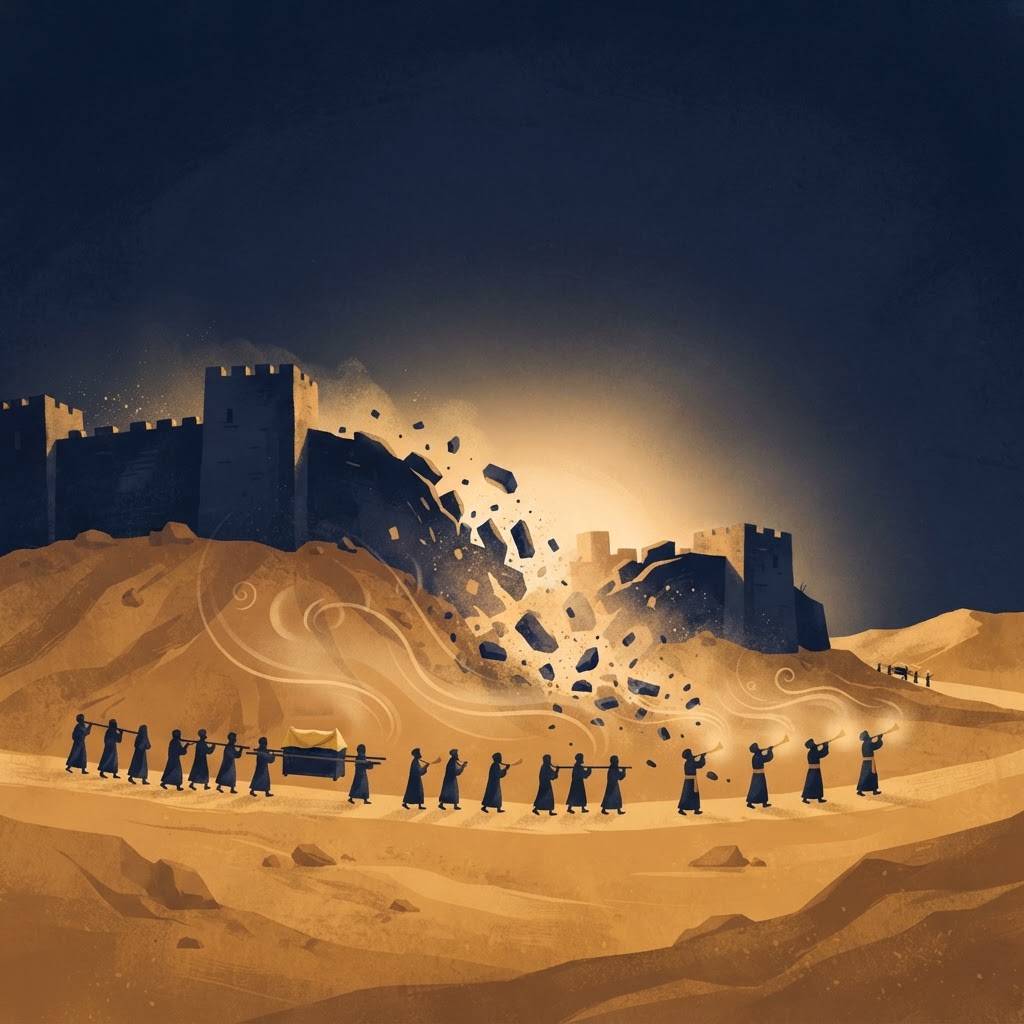
After crossing the Jordan River, Israel faced Jericho — a fortified city with massive walls. God's battle plan was unlike anything a military strategist would devise: march around the city once a day for six days, with seven priests carrying trumpets before the ark. On the seventh day, march around seven times, then have the priests blow the trumpets, and 'when they make a long blast with the ram's horn, when you hear the sound of the trumpet, then all the people shall shout with a great shout, and the wall of the city will fall up flat' (Joshua 6:5).

Israel obeyed. For six days they marched in silence. On the seventh day, they circled seven times, the trumpets sounded, the people shouted — 'and the wall fell down flat, so that the people went up into the city, every man straight before him, and they captured the city' (Joshua 6:20).

Jericho was under 'devotion to destruction' (herem) — everything was to be destroyed except Rahab and her family, who had hidden the Israelite spies because she believed 'the LORD your God, he is God in the heavens above and on the earth beneath' (Joshua 2:11). A Canaanite prostitute became an ancestor of David and, ultimately, of Jesus Christ (Matthew 1:5).

The World at That Time

Jericho is one of the oldest continuously inhabited cities in the world, with settlements dating back to 9000 BC. By the time of Joshua (c. 1400 BC), it was a small but heavily fortified city, occupying about 8-10 acres. Its walls were impressive: an outer retaining wall about 12-15 feet high, with a mudbrick wall on top reaching perhaps 25-30 feet total. An inner wall was equally massive.

Archaeological excavations at Jericho (Tell es-Sultan) have revealed evidence of collapsed walls from the Late Bronze Age, though dating is debated. Some archaeologists place the destruction layer at the correct period for Joshua's conquest; others dispute the dating. Regardless, the biblical account describes a miraculous collapse — not a siege or assault.

The 'trumpets' used were shofars — curved ram's horns. In ancient Israel, the shofar was used for religious and military signaling, to announce festivals, coronations, and battle. The seven-day march with seven priests and seven circuits on the seventh day reflects the biblical symbolism of completeness — seven representing God's perfect work.

Faith Reflection

God's plans often look foolish to the world. March around a city in silence? Blow horns? Shout? No army in history has won a battle this way. But that's precisely the point. When God gives the victory, there is no doubt who deserves the glory.

Joshua didn't modify God's plan. He didn't add his own strategies. He simply obeyed — even when the instructions made no military sense. Obedience doesn't require understanding; it requires trust.

Rahab's inclusion is the grace note of the story. A foreigner, a prostitute, a woman who by every standard should have been destroyed with the city — instead, she and her family were saved because she believed. God's grace has always reached beyond His people to include outsiders who believe. The walls fell for Israel; the scarlet cord held for Rahab. Both are pictures of salvation by faith.

Scripture Reference

Joshua 2, 6; Hebrews 11:30-31

“Your word is a lamp to my feet and a light to my path.” — Psalm 119:105