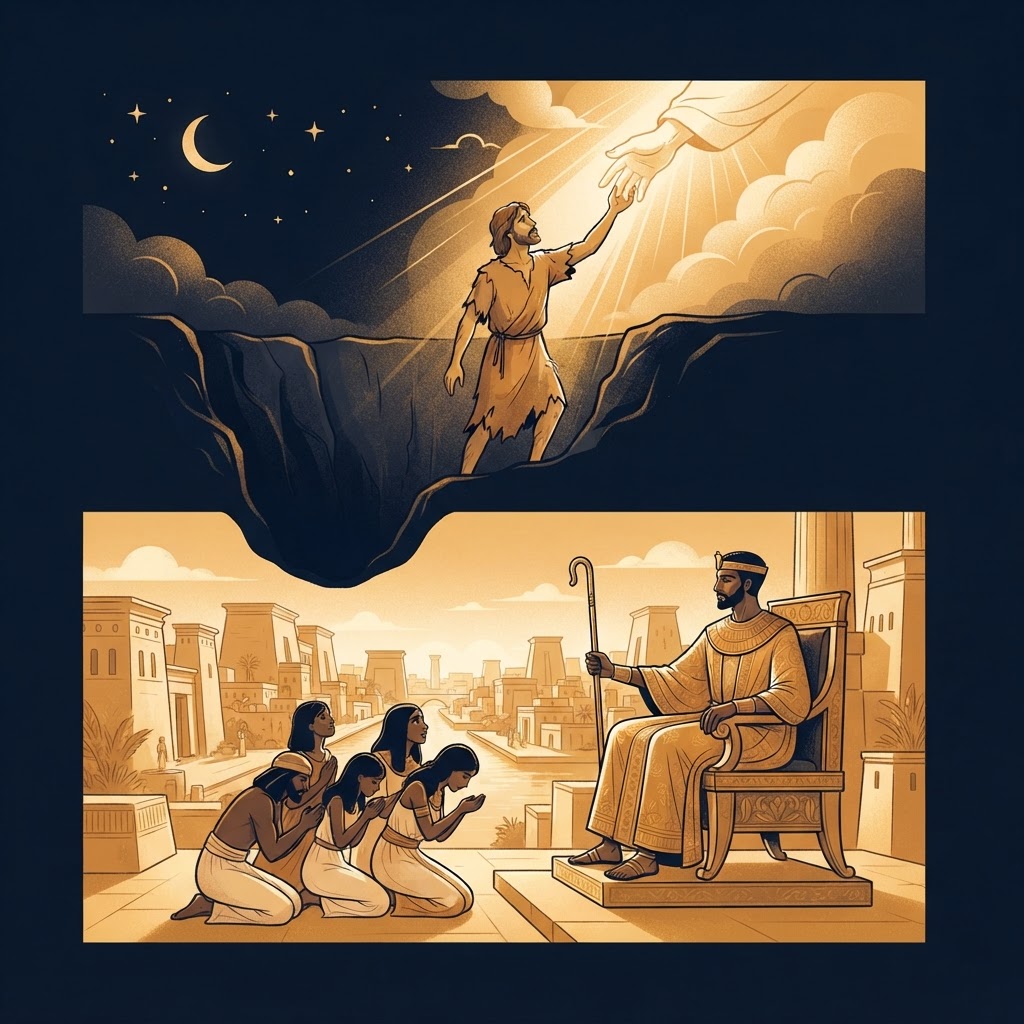
From Pit to Palace: The Hand of Providence
The Patriarchsc. 1800-1700 BC

From Pit to Palace: The Hand of Providence

Sold into slavery by his own brothers, Joseph rose from prison to the throne of Egypt — and saved the very family that betrayed him.

7 min read
Share

The Biblical Account

Joseph was Jacob's favorite son, given a 'robe of many colors' (Genesis 37:3). His brothers' jealousy turned to violence: they threw him into a pit, sold him to traders for twenty shekels of silver, and told Jacob that Joseph was dead.

In Egypt, Joseph was sold to Potiphar, falsely accused by Potiphar's wife, and thrown into prison. But 'the LORD was with Joseph' (Genesis 39:2, 39:21) — this phrase is the heartbeat of the story. In prison, Joseph interpreted dreams for Pharaoh's cupbearer and baker. Two years later, Pharaoh had a dream no one could interpret. The cupbearer remembered Joseph.

Joseph interpreted Pharaoh's dreams: seven years of abundance followed by seven years of famine. He proposed a plan to store grain during the good years. Pharaoh was so impressed that he made Joseph — a Hebrew slave and former prisoner — second in command of all Egypt: 'Only as regards the throne will I be greater than you' (Genesis 41:40).

When famine struck, Joseph's brothers came to Egypt to buy grain — and bowed before him, fulfilling the dreams that had started it all. After testing their hearts, Joseph revealed himself: 'You meant evil against me, but God meant it for good, to bring it about that many people should be kept alive' (Genesis 50:20).

The World at That Time

Joseph's story takes place during the Middle Kingdom period of Egypt (c. 1900-1700 BC), when Semitic peoples were known to enter Egypt. Excavations at Tell el-Dab'a (ancient Avaris) reveal a Semitic settlement in the Nile Delta during this period — consistent with the biblical account of Israelites in Egypt.

The price of twenty shekels was the standard price for a slave in the early second millennium BC, consistent with the period. The title Joseph received — 'father to Pharaoh' and 'ruler over all the land of Egypt' — fits Egyptian court language for a high-ranking vizier.

The seven-year famine is a known phenomenon in the ancient Near East. The Ipuwer Papyrus and other Egyptian texts describe periods of severe famine. A stele from the reign of Pharaoh Djoser describes a seven-year famine, suggesting such cycles were real and devastating.

Joseph's story bridges the patriarchal and exodus eras. His death at 110 (Genesis 50:22) marked the end of the patriarchal age. His bones were carried out of Egypt by Moses (Exodus 13:19) and finally buried in Shechem (Joshua 24:32) — a promise fulfilled across four centuries.

Faith Reflection

Joseph's life is the masterclass in trusting God's providence. Thirteen years of slavery and prison — and at no point did God abandon him. Every setback was a setup. The pit led to Potiphar's house. The false accusation led to prison. The prison led to Pharaoh's throne.

When you're in the pit, you can't see the palace. When you're in prison, you can't see the plan. But God is weaving threads you cannot see, through circumstances you did not choose, toward purposes you cannot yet imagine.

Joseph's final word to his brothers — 'You meant evil against me, but God meant it for good' — is the interpretive key to all suffering. God doesn't cause evil, but He is never defeated by it. He works through betrayal, false accusation, and injustice to accomplish His saving purposes. The cross is the ultimate proof: the worst act in human history — the murder of God's Son — became the means of salvation for the world.

Scripture Reference

Genesis 37, 39-50

“Your word is a lamp to my feet and a light to my path.” — Psalm 119:105