Fire Upon Mount Carmel: Elijah and the Showdown
The Divided Kingdomc. 870 BC

Fire Upon Mount Carmel: Elijah and the Showdown

One prophet faced four hundred and fifty false prophets — and God answered with fire, proving He alone is God.

7 min read
Share

The Biblical Account

After Solomon's death, the kingdom split. The northern kingdom of Israel fell into idolatry under King Ahab and his Phoenician wife Jezebel, who promoted the worship of Baal and killed the LORD's prophets. Elijah the Tishbite appeared before Ahab with a word from God: 'As the LORD, the God of Israel, lives, before whom I stand, there shall be neither dew nor rain these years, except by my word' (1 Kings 17:1).

After three and a half years of drought, Elijah challenged Ahab: 'Gather all Israel to me at Mount Carmel, and the 450 prophets of Baal and the 400 prophets of Asherah' (1 Kings 18:19). The contest was simple: each side would prepare a bull on an altar, but not set fire to it. 'The God who answers by fire, he is God' (1 Kings 18:24).

The prophets of Baal called on their god from morning to noon — 'O Baal, answer us!' They danced, shouted, and cut themselves with swords. Nothing. Elijah mocked them: 'Cry aloud, for he is a god. Either he is musing, or he is relieving himself, or he is on a journey, or perhaps he is asleep and must be awakened' (1 Kings 18:27).

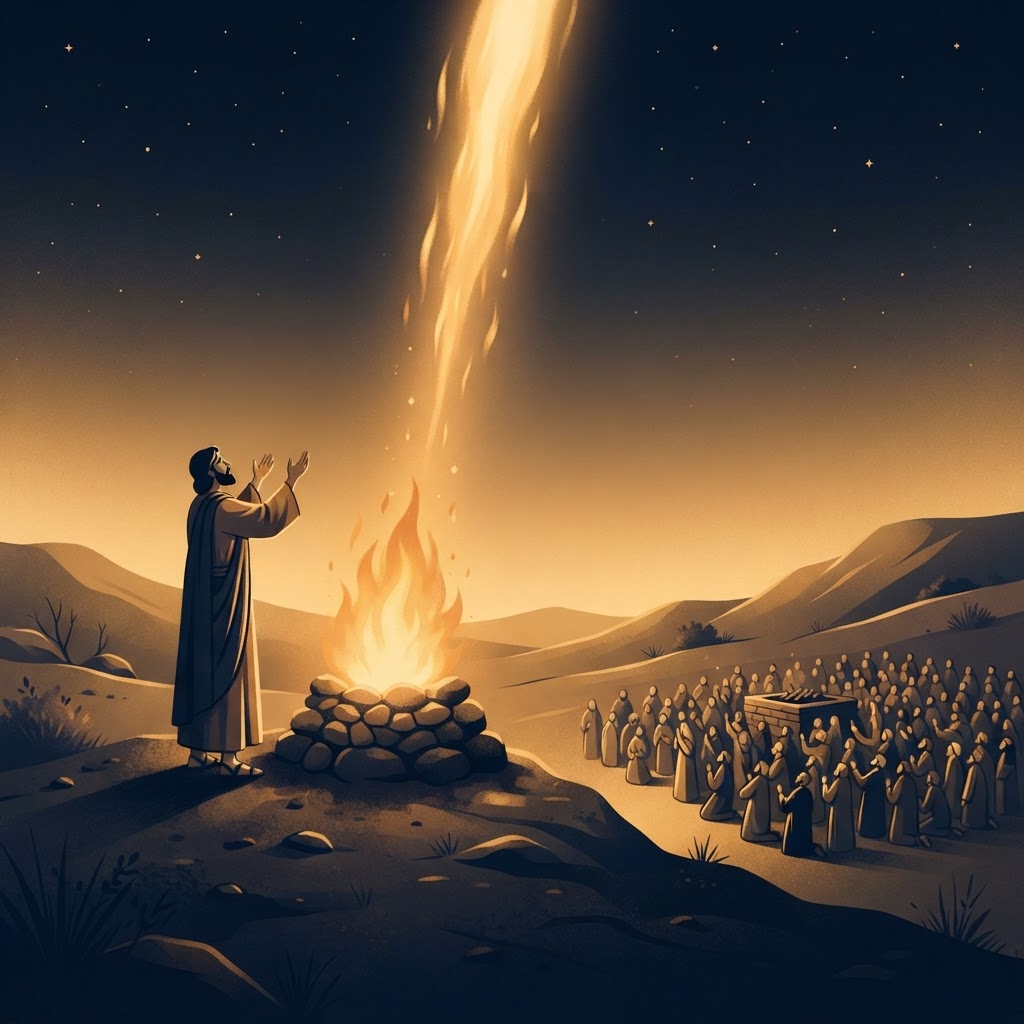
Then Elijah rebuilt the LORD's altar with twelve stones, dug a trench, soaked the offering and wood with water three times — and prayed: 'Answer me, O LORD... that this people may know that you, O LORD, are God' (1 Kings 18:37). Fire fell from heaven, consuming the offering, the wood, the stones, the dust, and the water in the trench. The people fell: 'The LORD, he is God; the LORD, he is God' (1 Kings 18:39).

The World at That Time

Baal was the Canaanite storm god — the lord of rain, lightning, and fertility. In a drought, the contest on Carmel was a direct theological challenge: whose god controls the rain? Baal was supposed to. Elijah's challenge struck at the heart of Canaanite religion.

Mount Carmel is a ridge in northern Israel, jutting into the Mediterranean Sea. Its elevation and location made it a natural site for rainfall — a fitting place to test whether Baal could bring rain. The ancient road along Carmel's ridge was a significant trade route.

The four hundred and fifty prophets of Baal — and four hundred of Asherah — represented the state-sponsored religious establishment of Ahab and Jezebel. Elijah was alone, the last prophet of the LORD. Or so he thought — God later told him He had '7,000 in Israel, all the knees that have not bowed to Baal' (1 Kings 19:18).

The soaking of the altar with water — 'twelve jars' (1 Kings 18:33-35) — during a severe drought was a deliberate escalation. Elijah was making it impossible (humanly speaking) for the offering to ignite. The fire that fell consumed not just the sacrifice but the very stones — evidence that this was no natural phenomenon.

The aftermath was sobering. Elijah had the prophets of Baal killed at the Kishon Brook. Then Jezebel threatened his life — and the prophet who had faced down 450 false prophets fled in fear into the desert, asking God to let him die (1 Kings 19:4). God's response was not rebuke but gentleness: food, rest, and a still, small voice.

Faith Reflection

Elijah's story teaches us about both boldness and weakness. He stood alone against an entire false religious system, trusting completely that God would answer. He was a man of extraordinary faith — and yet, within hours of his greatest victory, he was running in terror from one woman's threat.

James reminds us: 'Elijah was a man with a nature like ours' (James 5:17). The same man who called down fire from heaven also collapsed in depression under a broom tree. This should encourage us. God uses ordinary, flawed, fearful people to accomplish His purposes. Our weakness doesn't disqualify us — it's the very condition for God's strength.

God's response to Elijah's depression is tender. He didn't lecture him. He gave him bread and water. He let him sleep. Then, in the stillness, God spoke — not in the wind, not in the earthquake, not in the fire, but in a gentle whisper. God's power is not only in the dramatic. Sometimes His most powerful work is in the quiet — restoring a broken servant for the next chapter of His purpose.

After the fire comes the whisper. After the victory comes the exhaustion. After the calling comes the sustaining grace. And through it all, God is saying: I am with you. You are not alone.

Scripture Reference

1 Kings 17-19; James 5:17-18

“Your word is a lamp to my feet and a light to my path.” — Psalm 119:105