A New Heaven and a New Earth: The Renewal of All Things
Revelation & End TimesEternal

A New Heaven and a New Earth: The Renewal of All Things

The Bible ends not with destruction but with renewal — God making all things new, wiping every tear, and dwelling with His people forever.

6 min read
Share

The Biblical Account

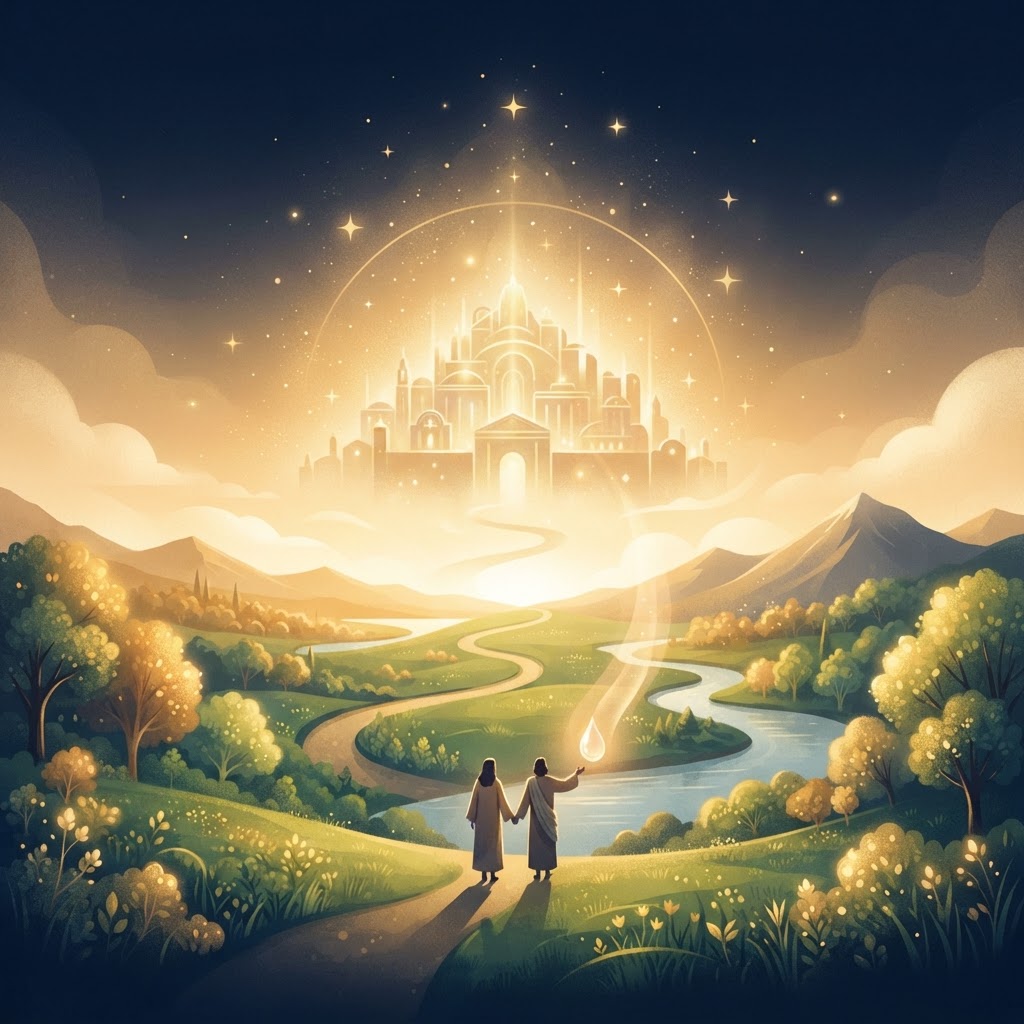
Revelation's final chapters (21-22) are the climax of all Scripture. John sees 'a new heaven and a new earth, for the first heaven and the first earth had passed away' (Revelation 21:1). The sea — symbol of chaos and separation — is no more. The Holy City, the new Jerusalem, comes down from heaven 'prepared as a bride adorned for her husband' (21:2).

A loud voice declares: 'Behold, the dwelling place of God is with man. He will dwell with them, and they will be his people, and God himself will be with them as their God. He will wipe away every tear from their eyes, and death shall be no more, neither shall there be mourning, nor crying, nor pain anymore, for the former things have passed away' (21:3-4).

God speaks: 'Behold, I am making all things new' (21:5). The one seated on the throne says, 'It is done! I am the Alpha and the Omega, the beginning and the end' (21:6).

The new creation has no temple, 'for its temple is the Lord God the Almighty and the Lamb' (21:22). It has no sun or moon, 'for the glory of God gives it light, and its lamp is the Lamb' (21:23). The river of the water of life flows from the throne, and 'the leaves of the tree were for the healing of the nations' (22:2). 'No longer will there be anything accursed' (22:3). 'They will see his face, and his name will be on their foreheads' (22:4).

The World at That Time

The imagery of Revelation draws deeply from the Old Testament — Ezekiel's vision of the new temple (Ezekiel 40-48), Isaiah's prophecies of new heavens and a new earth (Isaiah 65:17, 66:22), and Zechariah's vision of the Lord dwelling in Jerusalem (Zechariah 2:10-11, 14:8-11). John's original readers — first-century Christians facing persecution under Rome — would have heard this as a direct counterclaim to the empire's promise of 'peace and security.'

The 'new Jerusalem' would have struck ancient readers as audacious: a city without a temple, without a sun, without night. Every familiar structure of ancient urban life is replaced by the direct presence of God. This was not escapism — it was a subversive declaration that Rome's power was temporary and God's kingdom was eternal.

The Eden imagery is deliberate: a river, a tree of life, the presence of God walking with His people. Revelation is completing a circle that began in Genesis. What was lost in Eden is restored and surpassed in the new creation. The Bible begins with a garden and ends with a garden-city — growth, maturity, redemption.

Revelation was written during a period of intense pressure on early Christians, likely under Emperor Domitian (c. 81-96 AD). The visions encouraged believers that despite appearances, God was sovereign, history was going somewhere, and their suffering was not the final word.

Faith Reflection

The Bible doesn't end with us floating on clouds in a disembodied heaven. It ends with resurrection — a new earth, a city, bodies, relationships, culture, creativity. God doesn't abandon His creation; He redeems it. The new heaven and new earth are not a replacement but a renewal — the same world, healed and glorified.

Notice what's absent: death, mourning, crying, pain. These are not just physical realities — they are the emotional and spiritual scars of a fallen world. God doesn't just fix the outside; He heals the inside. 'He will wipe away every tear from their eyes' — this is intimate, personal, tender. God Himself will comfort you.

And what's present: God. 'Behold, the dwelling place of God is with man.' The deepest longing of the human heart — to be fully known and fully loved, to be with God and see His face — is fulfilled. Everything else — the gold, the jewels, the river, the tree — is secondary. The supreme joy of the new creation is simply: God is with us, and we see Him.

This is our hope. Not an escape from the world, but the world made new. Not a disembodied existence, but resurrection life. Not a distant God, but Immanuel — God with us, forever.

Scripture Reference

Revelation 21-22; Isaiah 65:17; 2 Peter 3:13

“Your word is a lamp to my feet and a light to my path.” — Psalm 119:105