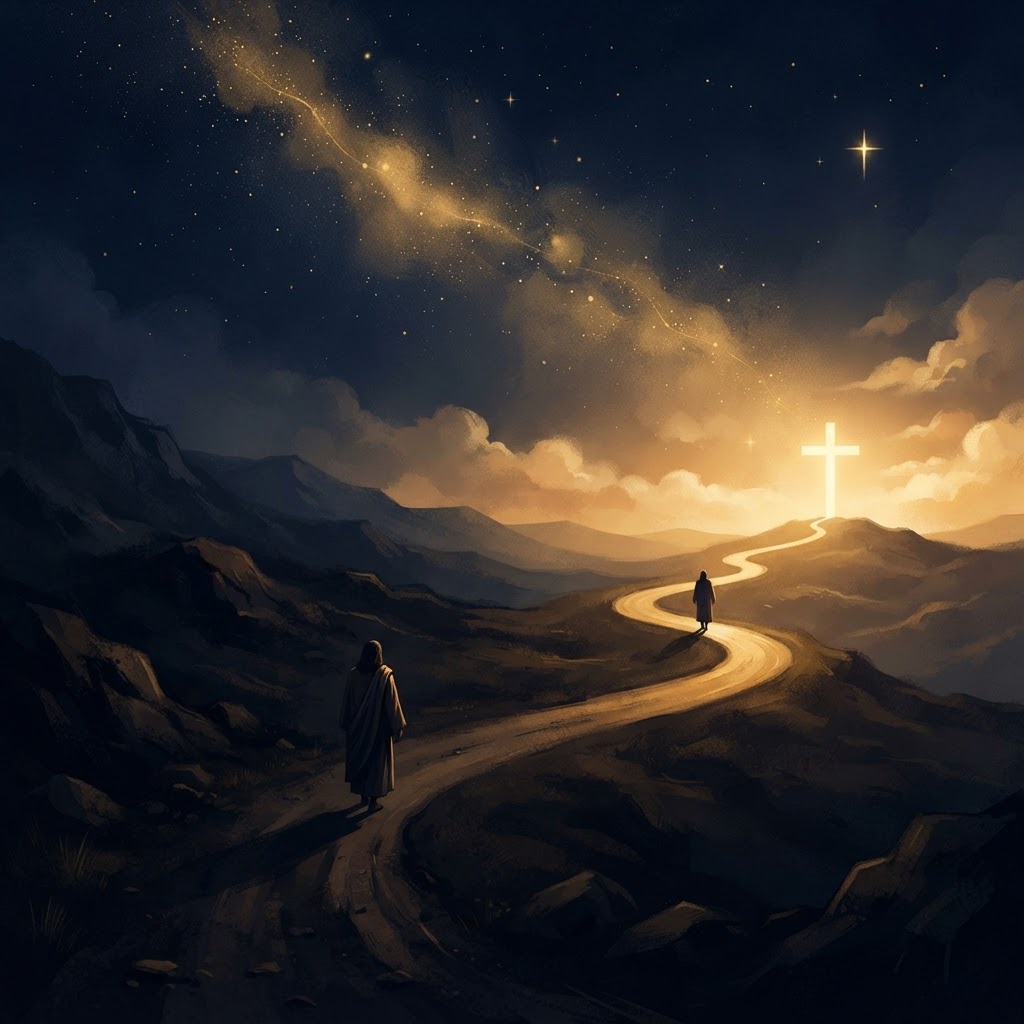
The Road to Salvation: Walking the Romans Road
The Romans Roadc. 57 AD

The Road to Salvation: Walking the Romans Road

A series of verses from Paul's letter to the Romans maps the journey from sin to salvation — the clearest presentation of the gospel in Scripture.

6 min read
Share

The Biblical Account

Paul's letter to the Romans is the most systematic theological treatise in the New Testament. Written around 57 AD to the church in Rome, it unfolds the gospel message with precision and passion. The 'Romans Road' is a path through this letter, using key verses to trace the journey from sin to salvation.

Step 1 — Our need: 'For all have sinned and fall short of the glory of God' (Romans 3:23). Every person — no exceptions — is a sinner.

Step 2 — The consequence: 'For the wages of sin is death' (Romans 6:23). Sin earns a wage — and that wage is death.

Step 3 — God's provision: 'But the free gift of God is eternal life in Christ Jesus our Lord' (Romans 6:23). The wage is earned; the gift is free.

Step 4 — The demonstration: 'But God shows his love for us in that while we were still sinners, Christ died for us' (Romans 5:8). He didn't wait for us to clean up; He came to us at our worst.

Step 5 — The response: 'If you confess with your mouth that Jesus is Lord and believe in your heart that God raised him from the dead, you will be saved' (Romans 10:9). Salvation is received by faith — trusting in what Christ has done, not what we have done.

Step 6 — The assurance: 'Everyone who calls on the name of the Lord will be saved' (Romans 10:13). Not 'might be' — 'will be.'

The World at That Time

Paul's letter to the Romans was written from Corinth around 57 AD, near the end of his third missionary journey. He had not yet visited Rome, but he longed to (Romans 1:10-13). The letter served as his theological self-introduction to a church he planned to visit and a church he hoped would support his mission to Spain (Romans 15:23-24).

The church in Rome was likely founded by Jewish believers who had been in Jerusalem at Pentecost (Acts 2:10). In 49 AD, Emperor Claudius expelled all Jews from Rome due to disputes 'about Chrestus' (likely Christ) — a decree that affected the church's composition. By the time Paul wrote, the Roman church included both Jewish and Gentile believers, and tensions between them were high.

The 'Romans Road' as an evangelistic tool is a modern formulation. While the verses are certainly from Romans, the specific sequence and framing emerged in the 20th century as a memorable way to present the gospel. The theological content, however, is pure Paul — and has been used by God to convert countless souls throughout history.

Augustine's conversion in 386 AD came from reading Romans. Martin Luther's Reformation breakthrough came from Romans 1:17. John Wesley's 'heart-warming' experience at Aldersgate in 1738 came from hearing Luther's preface to Romans. The letter to the Romans has been the engine of revival and reformation for two thousand years.

Faith Reflection

The Romans Road is the gospel distilled. It answers the four questions every person must answer: What is wrong with the world? (Sin.) Why does it matter? (Death.) What has God done? (Christ died and rose.) What must I do? (Believe and confess.)

This is not a formula to be recited but a truth to be received. The issue is not intellectual assent but wholehearted trust. Believing 'in your heart' means more than mental agreement; it means staking your life on it. Confessing 'Jesus is Lord' means more than saying words; it means surrendering control. In the Roman world, 'Caesar is Lord' was the loyalty oath every citizen was expected to take. To confess 'Jesus is Lord' was to declare that Caesar was not — and to accept the consequences.

'Everyone who calls on the name of the Lord will be saved.' Not 'might be.' Not 'could be.' Will be. The promise is certain because the One who makes it is faithful.

Scripture Reference

Romans 3:23, 5:8, 6:23, 10:9, 10:13

“Your word is a lamp to my feet and a light to my path.” — Psalm 119:105