The Fruit of the Spirit: Evidence of a Life Transformed
The Fruits of the Spiritc. 48-55 AD

The Fruit of the Spirit: Evidence of a Life Transformed

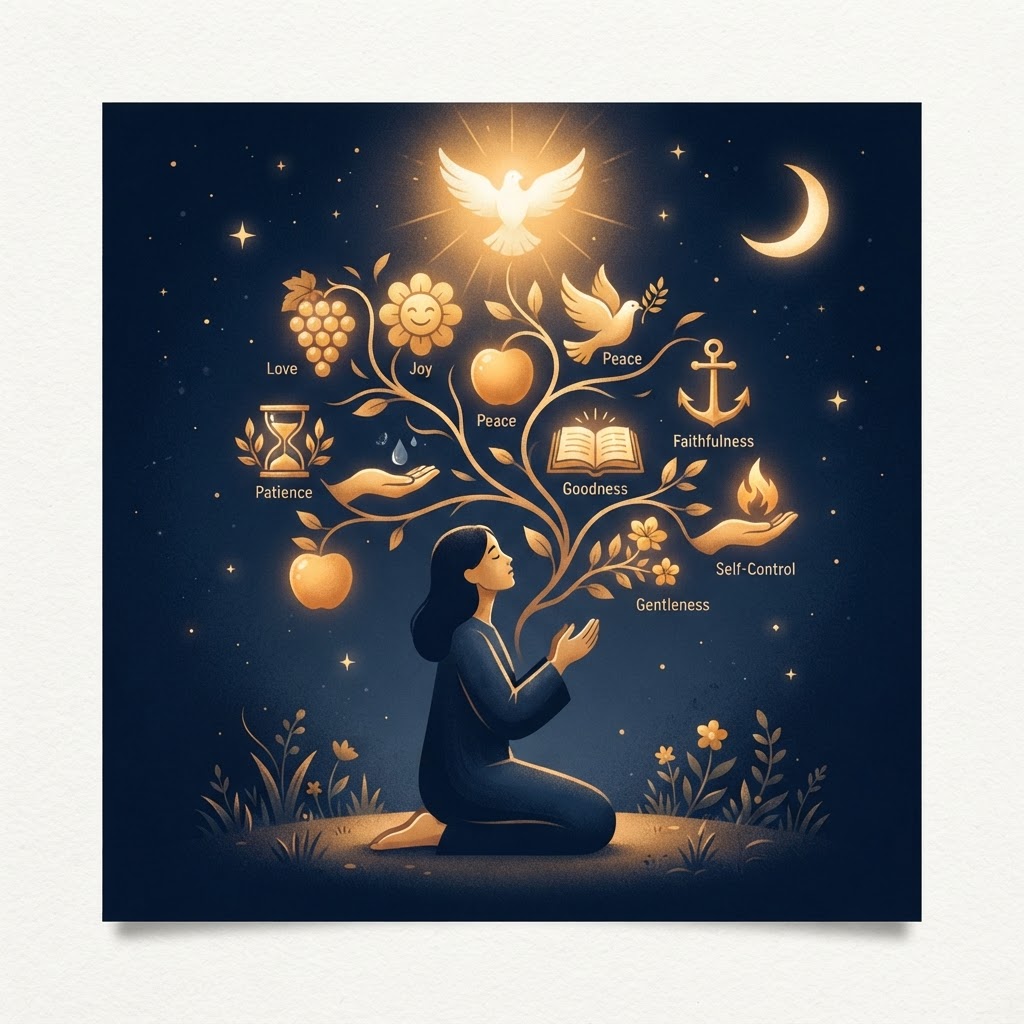
When the Holy Spirit fills a life, He produces fruit that cannot be manufactured: love, joy, peace, patience, kindness, goodness, faithfulness, gentleness, and self-control.

6 min read
Share

The Biblical Account

In Galatians 5, Paul contrasts two ways of living: 'the works of the flesh' — the natural product of human effort apart from God — and 'the fruit of the Spirit' — the supernatural result of the Holy Spirit's indwelling presence.

The works of the flesh are exhausting: 'sexual immorality, impurity, sensuality, idolatry, sorcery, enmity, strife, jealousy, fits of anger, rivalries, dissensions, divisions, envy, drunkenness, orgies, and things like these' (Galatians 5:19-21). They are the fruit of a life turned in on itself — self-gratification, self-promotion, self-destruction.

The fruit of the Spirit is entirely different: 'But the fruit of the Spirit is love, joy, peace, patience, kindness, goodness, faithfulness, gentleness, self-control; against such things there is no law' (Galatians 5:22-23). Notice: it is fruit (singular), not fruits. These are not nine separate qualities to be cultivated independently — they are one organic whole, the natural product of a Spirit-filled life. When the Spirit fills you, all nine grow together.

Paul's conclusion: 'And those who belong to Christ Jesus have crucified the flesh with its passions and desires. If we live by the Spirit, let us also keep in step with the Spirit' (Galatians 5:24-25). The Christian life is not about trying harder to be good — it's about walking with the Spirit, yielding to His work, and letting Him produce in you what you could never produce on your own.

Each fruit is a reflection of Christ's character. Love — 'God is love' (1 John 4:8). Joy — 'for the joy that was set before him endured the cross' (Hebrews 12:2). Peace — 'my peace I give to you' (John 14:27). Patience — 'The Lord is not slow... but is patient toward you' (2 Peter 3:9). Kindness — 'God's kindness is meant to lead you to repentance' (Romans 2:4). Goodness — 'No one is good except God alone' (Mark 10:18). Faithfulness — 'God is faithful' (1 Corinthians 1:9). Gentleness — 'I am gentle and lowly in heart' (Matthew 11:29). Self-control — He 'endured' for the joy set before Him.

The World at That Time

Paul's letter to the Galatians (c. 48-55 AD) was written to churches in the Roman province of Galatia (modern central Turkey). The central issue was: how are people made right with God? Some teachers (Judaizers) claimed that Gentile believers needed to be circumcised and follow the Jewish law to be saved. Paul vehemently opposed this: 'For freedom Christ has set us free; stand firm therefore, and do not submit again to a yoke of slavery' (Galatians 5:1).

The contrast between 'works' (erga) and 'fruit' (karpos) is significant. Works are what you produce by effort. Fruit is what grows naturally from a living connection. Jesus used the same imagery: 'I am the vine; you are the branches. Whoever abides in me and I in him, he it is that bears much fruit, for apart from me you can do nothing' (John 15:5). Fruit cannot be forced — it can only be grown.

The ancient world valued many of these qualities, but not as a package. Greek philosophers praised self-control (sophrosyne) and gentleness (praotes). Roman culture valued faithfulness (fides) and goodness. But the combination — and the source — was unique. Paul's point was that these qualities are not the product of human discipline but of divine indwelling. The Spirit produces what the law could never demand.

The word 'fruit' (karpos) was rich with meaning. In an agricultural society, fruit was the evidence of life and health. A good tree bears good fruit (Matthew 7:17). Fruit takes time — it cannot be rushed. And fruit is for others — apples don't eat themselves. The fruit of the Spirit is not for our private consumption; it is for the blessing of others and the glory of God.

Faith Reflection

The fruit of the Spirit is not a to-do list — it is a diagnosis. These qualities are the evidence of the Spirit's work in your life. You don't produce them by trying; you receive them by abiding.

This is both liberating and humbling. Liberating, because the pressure is off — you are not trying to manufacture love, joy, and patience through sheer willpower. Humbling, because the fruit reveals the true condition of your heart. If the fruit is absent — if your life is characterized by anger, strife, jealousy, and impurity — it may mean the Spirit is not being given room to work.

Notice the order: love comes first. 'The greatest of these is love' (1 Corinthians 13:13). Love is the soil from which all other fruit grows. Joy is love rejoicing. Peace is love resting. Patience is love enduring. Kindness is love acting. Goodness is love choosing what is right. Faithfulness is love keeping its promises. Gentleness is love restrained. Self-control is love mastering self.

The key is in verse 25: 'keep in step with the Spirit.' This is a walking metaphor — not running, not sprinting, but walking. Step by step. Day by day. Keeping pace with where the Spirit is leading. It's not about spectacular spiritual experiences; it's about daily, ordinary faithfulness. Listening. Obeying. Yielding. Repenting. Trusting.

A tree doesn't strain to produce fruit. It simply abides — rooted, connected, nourished. And the fruit comes. So it is with us. 'Abide in me, and I in you. As the branch cannot bear fruit by itself, unless it abides in the vine, neither can you, unless you abide in me' (John 15:4). The fruit will come. Just abide.

Scripture Reference

Galatians 5:16-25; John 15:1-17; Romans 8:5-14

“Your word is a lamp to my feet and a light to my path.” — Psalm 119:105