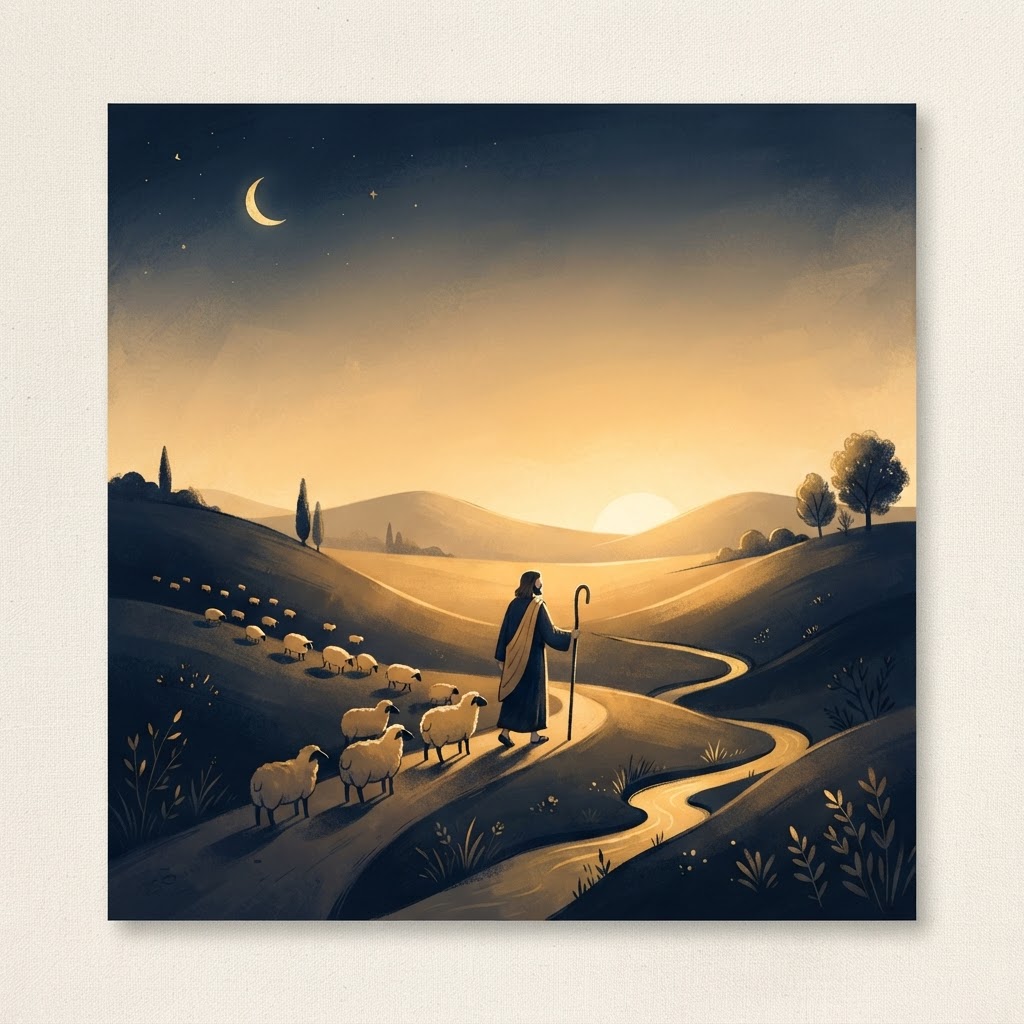
The Lord Is My Shepherd: Psalm 23 and the God Who Provides
Psalmsc. 1000 BC

The Lord Is My Shepherd: Psalm 23 and the God Who Provides

The most beloved psalm ever written paints a picture of God as a personal, tender, present Shepherd — who leads, feeds, protects, and dwells with His sheep.

6 min read
Share

The Biblical Account

Psalm 23 is arguably the most known and loved passage in all of Scripture. Attributed to David — who knew sheep before he knew kingship — it uses the imagery of a shepherd and his flock to describe God's care for His people.

'The LORD is my shepherd; I shall not want' (v. 1). God is not a distant deity — He is 'my shepherd.' Personal. Present. Intimate. And because He is, 'I shall not want' — not 'I shall not need' but 'I shall not lack.' The sheep are fully provided for.

'He makes me lie down in green pastures. He leads me beside still waters. He restores my soul' (vv. 2-3a). Green pastures — abundance. Still waters — peace. Restored soul — renewal. The shepherd doesn't just provide food and water; He provides rest, peace, and restoration.

'He leads me in paths of righteousness for his name's sake' (v. 3b). The shepherd leads — He doesn't drive from behind. And the path He leads on is the path of righteousness — not just any path, but the right one. Why? 'For his name's sake' — because God's character is at stake in how He treats His sheep.

'Even though I walk through the valley of the shadow of death, I will fear no evil, for you are with me; your rod and your staff, they comfort me' (v. 4). The psalm shifts from third person ('he') to second person ('you'). In the darkest valley, the sheep no longer talk about the shepherd — they talk to Him. His presence — not the absence of danger — is their comfort. The rod (for protection) and the staff (for guidance) are the shepherd's tools.

'You prepare a table before me in the presence of my enemies; you anoint my head with oil; my cup overflows' (v. 5). In the presence of enemies, God provides a feast. God's care is not diminished by opposition; it is amplified.

'Surely goodness and mercy shall follow me all the days of my life, and I shall dwell in the house of the LORD forever' (v. 6). 'Follow' is actually 'pursue' — God's goodness and mercy hunt down His sheep. And the destination is not a field or a fold, but 'the house of the LORD' — God's presence, forever.

The World at That Time

Psalm 23 is attributed to David, who began life as a shepherd boy in Bethlehem (1 Samuel 16:11). He knew sheep — their helplessness, their tendency to wander, their vulnerability to predators. He also knew what a shepherd did: leading to pasture, finding water, protecting from lions and bears (1 Samuel 17:34-35), rescuing from cliffs and thickets, carrying the weak. The metaphor was not abstract for David; it was his lived experience.

Shepherding in the ancient Near East was intimate. Unlike Western shepherds who often drive sheep from behind with dogs, Near Eastern shepherds lead from the front. The sheep know the shepherd's voice: 'The sheep hear his voice, and he calls his own sheep by name and leads them out... and the sheep follow him, for they know his voice' (John 10:3-4). The shepherd knows each sheep individually.

The 'valley of the shadow of death' (ge tsalmavet) may refer to a specific type of terrain — a deep, narrow ravine where shadows fall and predators lurk. These wadis (dry riverbeds) were often the only routes through mountainous terrain. A shepherd leading his flock through such a valley would walk ahead, staff in hand, watching for danger.

The 'rod' (shevet) was a short, heavy club used to defend against predators. The 'staff' (mish'enet) was a long pole with a crook at the end, used to guide sheep, rescue those caught in thorns, and lift fallen lambs. Both were essential tools of the trade.

The imagery of God as shepherd runs throughout Scripture. 'He is our God, and we are the people of his pasture, the sheep of his hand' (Psalm 95:7). 'I myself will be the shepherd of my sheep' (Ezekiel 34:15). And supremely, Jesus: 'I am the good shepherd. The good shepherd lays down his life for the sheep' (John 10:11). The shepherd of Psalm 23 became a sheep — the Lamb of God — to rescue His flock.

Faith Reflection

Psalm 23 is not a poem about sheep. It is a declaration of trust. In every circumstance — abundance and scarcity, rest and danger, feasting and enemies — the psalmist trusts the Shepherd.

Notice the pronoun shift in verse 4. For the first three verses, the psalmist talks about the shepherd: 'he makes me... he leads me... he restores me.' But when the valley comes, the pronoun changes: 'you are with me.' In the darkest moment, the psalmist stops talking about God and starts talking to Him. The valley doesn't drive us from God — it drives us to Him.

This is the message of the psalm: God's presence, not our circumstances, is our security. Green pastures and still waters are wonderful — but the valley of the shadow of death is where faith is tested. And in the valley, the Shepherd doesn't remove us from danger. He walks through it with us. 'For you are with me.'

The rod and staff — protection and guidance. The rod drives away the wolf. The staff pulls the sheep from the thicket. Both are forms of love. Sometimes God's love is fierce — defending us from what would destroy us. Sometimes it is gentle — pulling us back from the edges we've wandered to. Both are comfort.

And the end is not the valley. The end is the house of the LORD. The journey leads through pastures, through valleys, through feasts, through enemies — but it ends at home. In the presence of the Shepherd. Forever.

'The LORD is my shepherd.' Not 'was' — 'is.' Not 'might be' — 'is.' He is your shepherd. Right now. In the green pasture and in the dark valley. He is with you. His rod and staff are in His hands. His goodness and mercy are pursuing you. And He will bring you home.

Scripture Reference

Psalm 23; John 10:1-18; Ezekiel 34:11-16

More in Psalms

“Your word is a lamp to my feet and a light to my path.” — Psalm 119:105