Joseph and His Brothers: What You Meant for Evil, God Meant for Good
Genesisc. 1900-1700 BC

Joseph and His Brothers: What You Meant for Evil, God Meant for Good

Sold into slavery by his own brothers, Joseph rose to power in Egypt and saved the very family that betrayed him — the supreme Old Testament picture of providence and forgiveness.

6 min read
Share

The Biblical Account

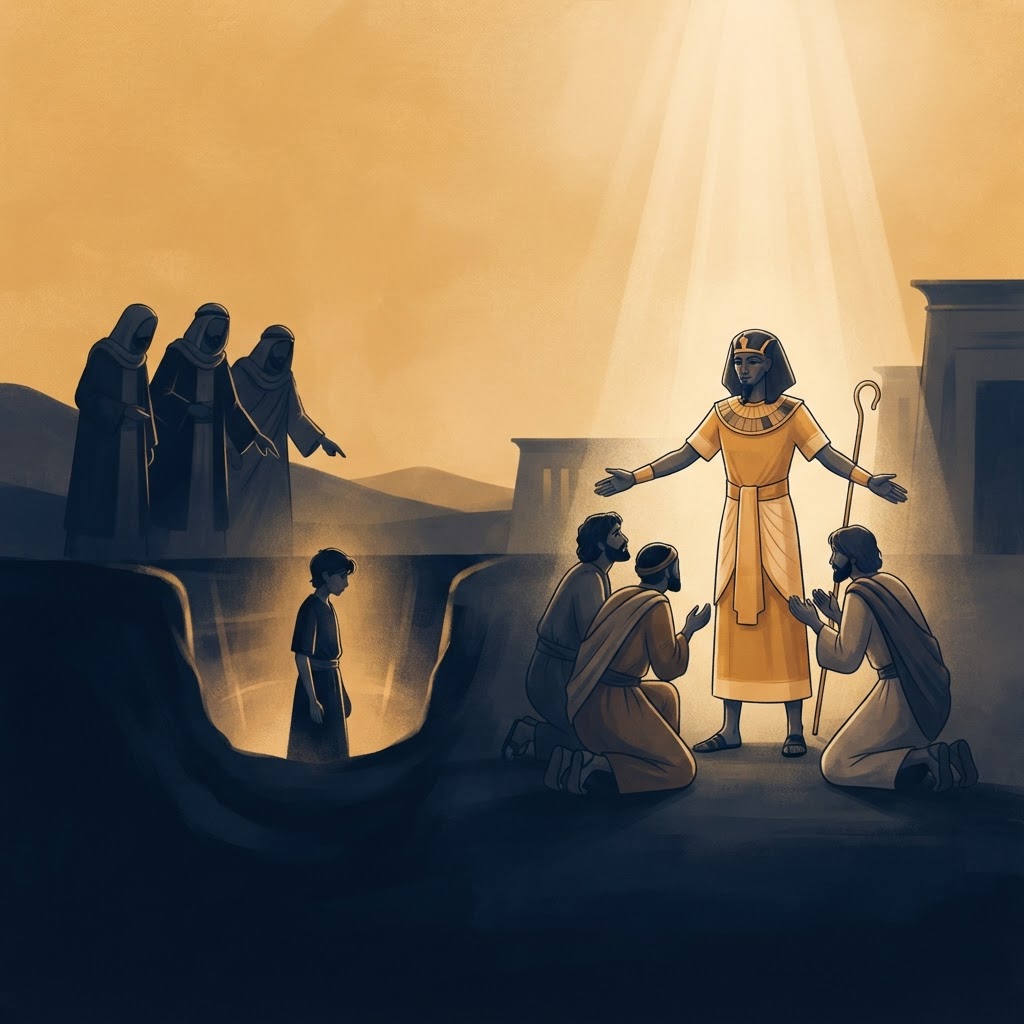
The story of Joseph (Genesis 37-50) is the longest single narrative in Genesis and one of the greatest stories ever told. Joseph was Jacob's favorite son, given 'a robe of many colors' (37:3). His brothers, jealous of his favored status and his prophetic dreams, sold him into slavery and told their father he was killed by a wild animal.

In Egypt, Joseph was sold to Potiphar, an officer of Pharaoh. He rose to manage Potiphar's household, was falsely accused by Potiphar's wife, and thrown into prison. Even in prison, he prospered: 'the LORD was with Joseph' (39:23). He interpreted dreams for Pharaoh's cupbearer and baker. Two years later, Pharaoh had a dream no one could interpret. The cupbearer remembered Joseph.

Joseph interpreted Pharaoh's dreams: seven years of abundance followed by seven years of famine. Pharaoh appointed Joseph as second-in-command over Egypt. When the famine hit, Joseph's brothers came to buy grain. They didn't recognize him. After testing their hearts (Genesis 42-44), Joseph revealed himself: 'I am Joseph! Is my father still alive?' (45:3).

Joseph's words to his brothers are among the most profound in Scripture: 'As for you, you meant evil against me, but God meant it for good, to bring it about that many people should be kept alive, as they are today' (50:20). Joseph saw God's hand in every chapter of his suffering — the pit, the slavery, the prison, the palace. It was all part of God's plan to preserve His people and advance His purposes.

The World at That Time

The Joseph narrative (Genesis 37-50) bridges the patriarchal era and the exodus. Joseph likely served under a Hyksos-era Pharaoh (the Hyksos were Semitic rulers of Egypt, c. 1650-1550 BC) or during the Middle Kingdom (c. 1900-1700 BC). The title 'overseer of the house' (Genesis 39:4) and the role of chief steward are well-attested in Egyptian records.

The 'robe of many colors' (Hebrew ketonet passim) was more likely a long-sleeved tunic — a garment of privilege, signaling that Joseph didn't do manual labor. Such garments are depicted in Egyptian and Canaanite art.

Dream interpretation was a well-established practice in the ancient Near East. Egyptian 'dream books' have been found that categorize dreams and their meanings. Joseph's ability to interpret dreams was attributed not to technique but to God: 'Do not interpretations belong to God?' (Genesis 40:8). The Egyptian magicians' inability to interpret Pharaoh's dreams set the stage for Joseph's rise.

The seven-year famine is historically plausible. Egyptian inscriptions record periods of severe famine. The storage of grain during years of plenty was standard Egyptian administrative practice, overseen by temple granaries.

Joseph's story has been recognized in literature and culture for millennia. It is the basis for the musical 'Joseph and the Amazing Technicolor Dreamcoat' (Andrew Lloyd Webber, 1968). But its theological depth — the providence of God working through human evil, the pattern of suffering before glory, the foreshadowing of Christ — is what makes it endure.

Faith Reflection

Joseph's story is the Old Testament's clearest picture of God's providence — His sovereign ability to work all things for good. Joseph didn't minimize the evil done to him. He named it: 'you meant evil against me.' But he also saw what his brothers couldn't: 'God meant it for good.' The same event — the sale into slavery — was both their evil act and God's good plan.

This is the mystery of providence. God doesn't cause evil, but He can use it. He doesn't tempt people to sin, but He can turn the worst human actions into the greatest good. The cross is the supreme example: 'this Jesus, delivered up according to the definite plan and foreknowledge of God, you crucified and killed by the hands of lawless men' (Acts 2:23). The worst crime in history — the murder of God's Son — was also the greatest good — the salvation of the world.

Joseph is also a type of Christ. He was the beloved son, rejected by his brothers, sold for the price of a slave, falsely accused, exalted to the right hand of the ruler, and the savior of his people. He forgave those who wronged him, provided for them in their need, and said: 'You meant evil against me, but God meant it for good.'

When you are in the pit — betrayed, falsely accused, forgotten — remember Joseph. Remember that God is working, even when you can't see it. Remember that the pit may be the path to the palace. And remember that the God who turned Joseph's betrayal into salvation is the same God who turned a cross into a resurrection.

What you meant for evil, God means for good.

Scripture Reference

Genesis 37-50; Romans 8:28; Acts 2:23

More in Genesis

“Your word is a lamp to my feet and a light to my path.” — Psalm 119:105