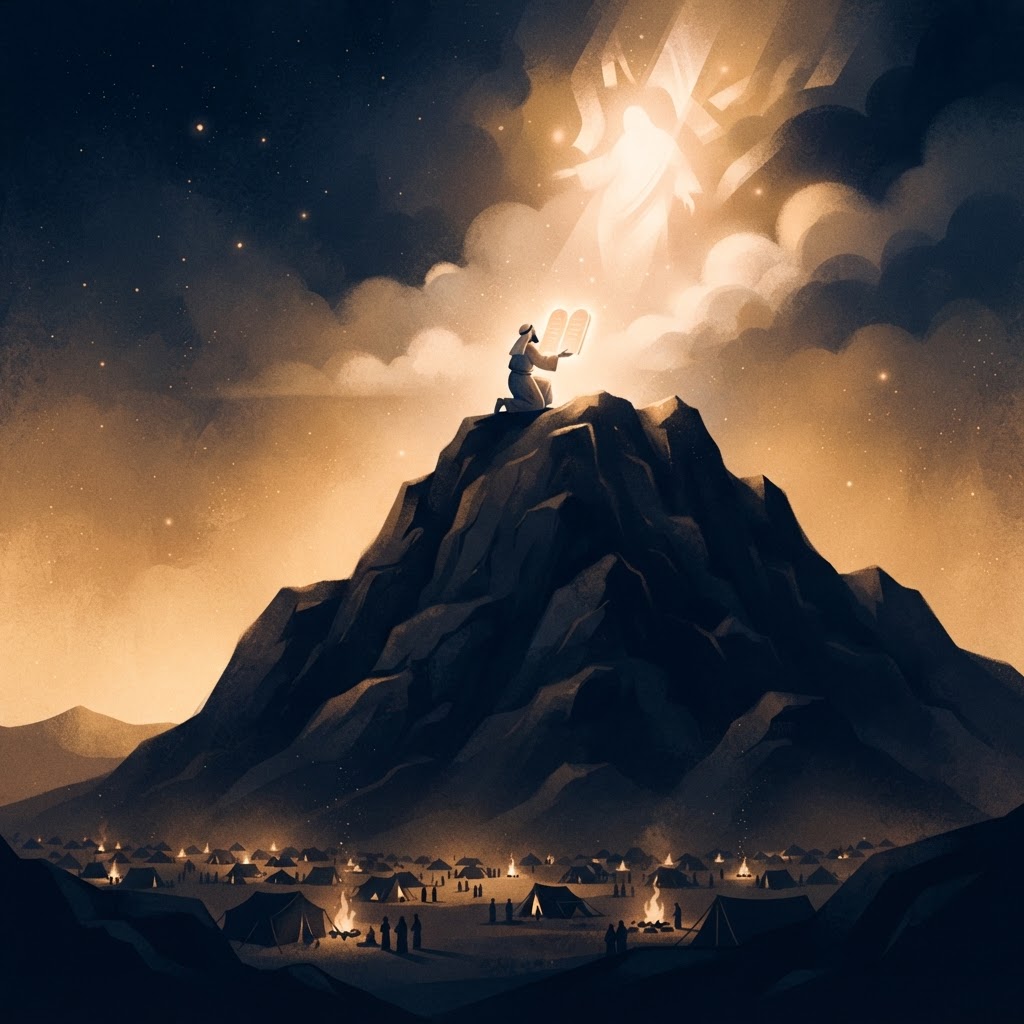
The Giving of the Law: Sinai and the Ten Commandments
Exodusc. 1446 BC

The Giving of the Law: Sinai and the Ten Commandments

At Mount Sinai, God gave Israel His Law — not as a burden, but as the blueprint for a holy people in covenant with a holy God.

6 min read
Share

The Biblical Account

Three months after leaving Egypt, Israel arrived at Mount Sinai. God declared: 'You shall be to me a kingdom of priests and a holy nation' (Exodus 19:6). The mountain was wrapped in smoke, fire, and thunder. 'Now Mount Sinai was wrapped in smoke because the LORD had descended on it in fire... the whole mountain trembled greatly' (19:18). God spoke the Ten Commandments directly to the people (Exodus 20, repeated in Deuteronomy 5).

The Ten Commandments are the moral foundation of the Law:

1. No other gods before me. 2. No idols. 3. Don't take God's name in vain. 4. Keep the Sabbath. 5. Honor father and mother. 6. Do not murder. 7. Do not commit adultery. 8. Do not steal. 9. Do not bear false witness. 10. Do not covet.

The first four govern our relationship with God; the last six govern our relationships with others. Jesus summarized them: 'You shall love the Lord your God with all your heart... You shall love your neighbor as yourself. On these two commandments depend all the Law and the Prophets' (Matthew 22:37-40).

The broader Law (Exodus 20-23) included civil, ceremonial, and moral regulations — covering worship, slavery, injury, property, justice, Sabbath, and festivals. The tabernacle instructions (Exodus 25-31) established how a holy God could dwell among a sinful people: through sacrifice, priesthood, and the mercy seat.

The Law was not a means of salvation — it was given to an already-redeemed people. 'I am the LORD your God, who brought you out of the land of Egypt, out of the house of slavery' (Exodus 20:2). Grace came before law. Redemption preceded regulation.

The World at That Time

Ancient Near Eastern law codes existed before Sinai — the Code of Ur-Nammu (c. 2100 BC), the Code of Lipit-Ishtar (c. 1900 BC), the Code of Hammurabi (c. 1750 BC). These codes governed Mesopotamian society. But the Mosaic Law was fundamentally different. Ancient codes were given by kings; Sinai's Law was given by God. Ancient codes favored the powerful; Mosaic Law protected the weak — the widow, orphan, foreigner. Ancient codes were situational; the Ten Commandments were absolute moral principles.

The structure of the Sinai covenant follows the pattern of ancient Near Eastern suzerainty treaties — agreements between a great king (suzerain) and a vassal state. These treaties included: a preamble ('I am the LORD'), historical prologue ('who brought you out of Egypt'), stipulations (the commandments), and blessings/curses. This format would have been immediately recognizable to Israel. God was establishing Himself as their Great King.

The theophany at Sinai — fire, smoke, earthquake, thunder — follows a pattern of divine appearances in the ancient world. But the uniqueness of Sinai was that God spoke directly to the entire nation: 'Has any people ever heard the voice of God speaking out of the midst of the fire, as you have heard, and still lived?' (Deuteronomy 4:33). In other religions, only the priest or king encountered the deity. At Sinai, God addressed His entire people.

The tabernacle — God's dwelling place among Israel — was constructed according to a heavenly pattern (Exodus 25:9, 40). The architecture (outer court, holy place, most holy place) and furniture (altar, laver, lampstand, table, altar of incense, ark of the covenant) all pointed to the holiness of God and the need for mediation. This system would last until Christ, who 'tabernacled' among us (John 1:14) and entered 'not into a sanctuary made with hands... but into heaven itself' (Hebrews 9:24).

Faith Reflection

The Law reveals God's character. Every commandment is a window into who God is and what He values. He is sole, supreme, and holy. He values truth, purity, life, marriage, property, and contentment. The Law is not arbitrary rules — it is the DNA of a holy people.

The Law also reveals our sin. 'Through the law comes knowledge of sin' (Romans 3:20). Who has never coveted? Never lied? Never placed something before God? The Law doesn't save us — it shows us that we need saving. 'The law was our guardian until Christ came, in order that we might be justified by faith' (Galatians 3:24).

This is why Sinai points to Calvary. The Law demanded perfection; Christ provided it. The Law required sacrifice; Christ became the sacrifice. The Law exposed sin; Christ forgave it. 'For what the law was powerless to do because it was weakened by the flesh, God did by sending his own Son in the likeness of sinful flesh to be a sin offering' (Romans 8:3).

The God who thundered from Sinai is the same God who whispered from Calvary: 'It is finished.' The mountain of law gives way to the mountain of grace (Hebrews 12:18-24). We don't approach God through smoke and fire, but through 'the blood of Jesus, the mediator of a new covenant.' The Law was given. The Lamb was slain. The way is open. 'Let us then with confidence draw near to the throne of grace' (Hebrews 4:16).

Scripture Reference

Exodus 19-20, 32-34; Romans 3:20, 8:3; Galatians 3:24; Hebrews 12:18-24

More in Exodus

“Your word is a lamp to my feet and a light to my path.” — Psalm 119:105