Boaz the Kinsman-Redeemer: The Gospel in a Grain Field
Ruthc. 1150 BC

Boaz the Kinsman-Redeemer: The Gospel in a Grain Field

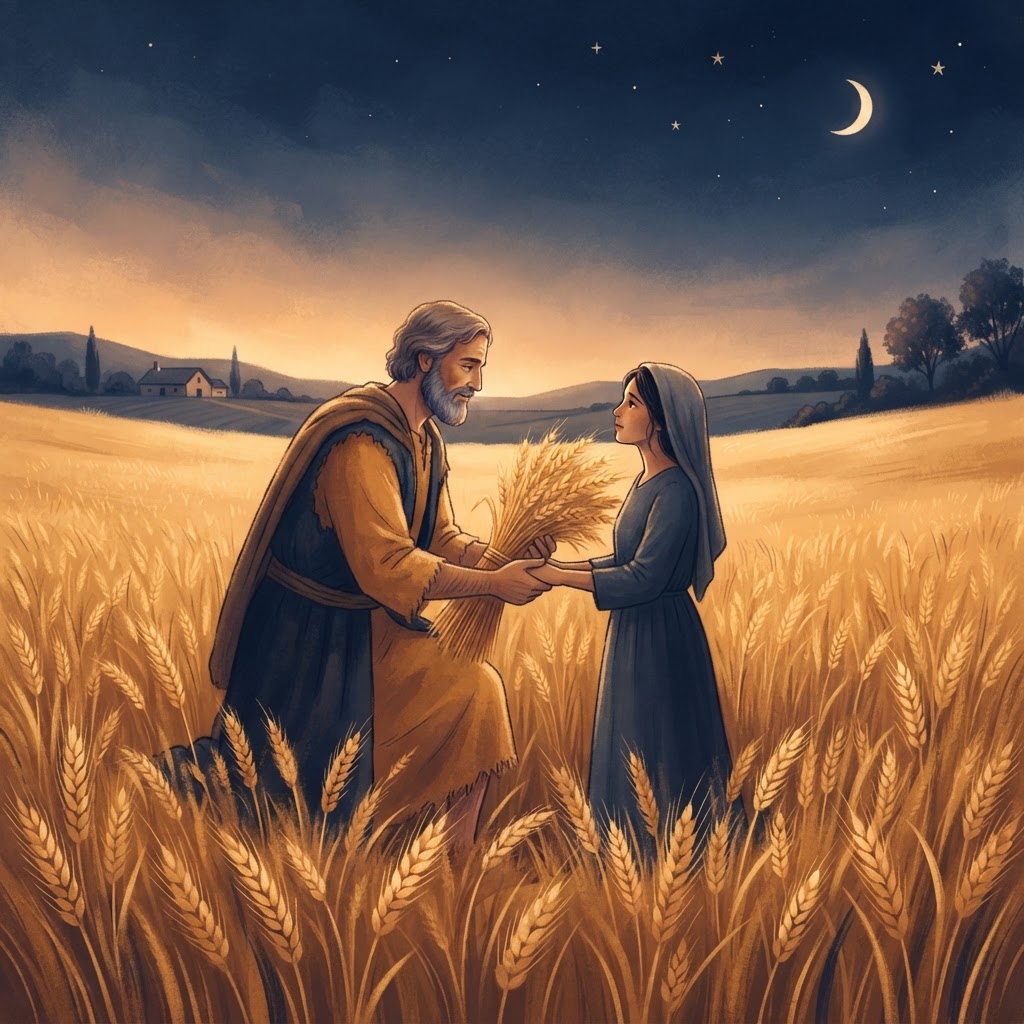
Boaz — a wealthy landowner who redeemed a Moabite widow — is one of the most beautiful pictures of Christ in the Old Testament: the one who pays the price and takes the stranger as his own.

6 min read
Share

The Biblical Account

The story of Boaz (Ruth 2-4) is the heart of the Book of Ruth. After Ruth's famous declaration of loyalty to Naomi ('Your God shall be my God'), the two widows returned to Bethlehem. Ruth went to glean in the fields to provide for them, and 'she happened to come to the part of the field belonging to Boaz' (Ruth 2:3) — a 'coincidence' orchestrated by God's providence.

Boaz was 'a worthy man of the clan of Elimelech' (Ruth 2:1) — a man of standing and character. When he noticed Ruth gleaning, he showed extraordinary kindness: 'Listen, my daughter... Do not go to glean in another field... Keep your eyes on the field that is being reaped and follow after them. I have charged the young men not to touch you' (2:8-9). He invited her to eat with his workers, told his reapers to leave extra grain for her, and ensured her safety.

Ruth asked why she had found such favor. Boaz replied: 'All that you have done for your mother-in-law since the death of your husband has been fully told to me... The LORD repay you for what you have done, and a full reward be given you by the LORD, the God of Israel, under whose wings you have come to take refuge' (2:11-12).

Naomi recognized God's hand: 'The man is a close relative of ours, one of our redeemers' (2:20). The kinsman-redeemer (go'el) was responsible to buy back land that a relative had lost, to marry a childless widow to preserve the family line, and to care for relatives in distress. At Naomi's instruction, Ruth went to Boaz at night and lay at his feet — a gesture requesting redemption. Boaz responded: 'I will do for you all that you ask, for all my fellow townsmen know that you are a worthy woman' (3:11).

There was one closer relative who had the first right to redeem. Boaz offered him the land and Ruth, but the closer relative declined, and Boaz redeemed her: 'I have bought... all that belonged to Elimelech and all that belonged to Chilion and to Mahlon... Ruth the Moabite... I have bought to be my wife' (4:9-10). Their son Obed became the grandfather of King David — and Boaz entered the lineage of the Messiah (Matthew 1:5).

The World at That Time

The kinsman-redeemer (go'el) was a provision in Israel's law for the protection of families and land. The land was God's (Leviticus 25:23); families were to keep their inheritance. If poverty forced a sale, a close relative could 'redeem' (buy back) the land so it stayed in the family. If a man died childless, his brother or closest relative was to marry the widow (levirate marriage, Deuteronomy 25:5-10) so the deceased's name would not be 'blotted out of Israel.'

Boaz was not the closest redeemer — there was 'a redeemer nearer than he' (Ruth 3:12). But Boaz was willing. The closer relative declined because marrying a Moabite widow and redeeming the land would 'impair my own inheritance' (4:6) — the land he redeemed would pass to the son of Ruth's first husband, not to his own line. Boaz, in contrast, was willing to sacrifice his own inheritance for the sake of Ruth and Naomi. His generosity is a picture of Christ, who 'did not count equality with God a thing to be grasped, but emptied himself' (Philippians 2:6).

The setting — Bethlehem during the barley harvest (Ruth 1:22, 2:23) — is significant. Bethlehem ('house of bread') was Elimelech's hometown, the place they had left because of famine. Now there was bread again — and Ruth, the outsider, would become part of the 'house of bread.' Centuries later, another child would be born in Bethlehem — the 'bread of life' (John 6:35), whose lineage included Boaz and Ruth.

The elders' blessing at the city gate (Ruth 4:11-12) invoked Rachel and Leah, the mothers of Israel, and the house of Perez (the son of Judah and Tamar). This genealogical note connects Ruth to the tribe of Judah, the royal tribe. The final genealogy (Ruth 4:18-22) traces the line from Perez to David — placing Ruth, a Moabite, in the most important family tree in Israel.

Faith Reflection

Boaz is one of the clearest Old Testament pictures of Christ. He was a wealthy kinsman who redeemed a poor, foreign widow — paying the price, taking her as his own, and giving her a future and a family. Jesus is our kinsman-redeemer — one who became like us ('in all things he had to be made like his brothers,' Hebrews 2:17), paid the price ('you were bought with a price,' 1 Corinthians 6:20), and took us as His own bride (Ephesians 5:25-27).

Consider the parallels. Ruth was a foreigner, an outsider, with no claim on Israel's God or Israel's people. Boaz didn't demand that she earn her way in; he provided for her, protected her, and ultimately paid the price to make her his own. We were 'separated from Christ, alienated from the commonwealth of Israel and strangers to the covenants of promise, having no hope and without God in the world' (Ephesians 2:12). Christ didn't demand we earn our way; He paid the price — 'not with perishable things such as silver or gold, but with the precious blood of Christ' (1 Peter 1:18-19).

Ruth's story began in a grain field. She was gleaning — gathering scraps left for the poor. But God, through Boaz, gave her abundance — not scraps, but a home, a husband, a son, and a place in the lineage of the Messiah. This is what grace does. It doesn't just give us enough to survive; it gives us more than we could ask or imagine (Ephesians 3:20).

'Under whose wings you have come to take refuge' (Ruth 2:12). Ruth came to God for refuge — and He gave her more than refuge. He gave her a redeemer. And He has done the same for us. 'How much more will the blood of Christ... purify our conscience from dead works to serve the living God' (Hebrews 9:14).

The grain field is still open. The Redeemer is still willing. Come.

Scripture Reference

Ruth 2-4; Leviticus 25:23-28; Deuteronomy 25:5-10; Matthew 1:5

More in Ruth

“Your word is a lamp to my feet and a light to my path.” — Psalm 119:105