Psalm 1: The Two Ways
Psalmsc. 1000-400 BC

Psalm 1: The Two Ways

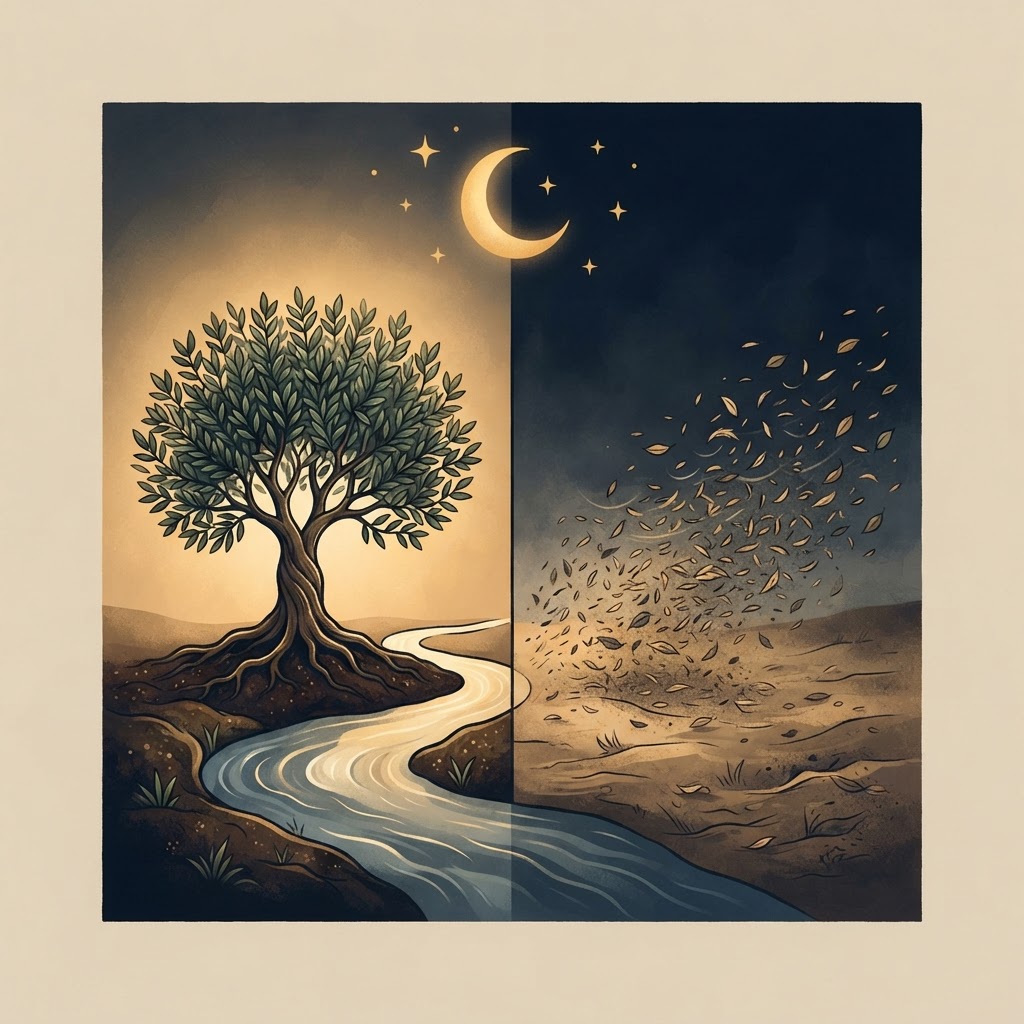
The Psalter opens with a choice: the way of the righteous, rooted like a tree by streams of water, or the way of the wicked, like chaff driven by the wind.

5 min read
Share

The Biblical Account

Psalm 1 is the gateway to the entire Book of Psalms. It sets the theme: there are two ways to live, and they lead to two very different outcomes.

'Blessed is the man who walks not in the counsel of the wicked, nor stands in the way of sinners, nor sits in the seat of scoffers' (v. 1). The progression is striking: walk, stand, sit. The one who listens to wrong counsel stops to consider, then settles in. Sin is always progressive — from passing interest to settled habit.

The righteous alternative: 'But his delight is in the law of the LORD, and on his law he meditates day and night' (v. 2). The word 'delight' (chephetz) means desire, pleasure. God's Word is not a duty but a delight. 'Meditates' (hagah) means to mutter, to chew on — like a cow chewing cud. The righteous person turns God's Word over and over, absorbing it into the heart.

The result: 'He is like a tree planted by streams of water that yields its fruit in its season, and its leaf does not wither. In all that he does, he prospers' (v. 3). The image is of a tree with deep roots, fed by a constant water source. It is stable, fruitful, and resilient. The tree doesn't choose where to grow — it is 'planted.' God placed it by the streams. Its fruitfulness comes not from effort but from being rooted in the right source.

The contrast: 'The wicked are not so, but are like chaff that the wind drives away' (v. 4). Chaff is the worthless husk around the grain, blown away in the winnowing process. It has no root, no weight, no substance. It is here today and gone tomorrow.

The conclusion: 'Therefore the wicked will not stand in the judgment, nor sinners in the congregation of the righteous; for the LORD knows the way of the righteous, but the way of the wicked will perish' (vv. 5-6). 'The LORD knows' — not just intellectually, but intimately. 'I never knew you' (Matthew 7:23) is the tragic verdict for those on the wrong path. To be 'known' by God is to belong to Him.

The World at That Time

Psalm 1 serves as the preface to the Psalter — the 150-poem hymnal of Israel. The Psalms were compiled over roughly 1,000 years (c. 1400-400 BC), with contributions from David (73 psalms), Asaph (12), the sons of Korah (11), Solomon (2), Moses (1), and many anonymous authors. The book is divided into five sections (Psalms 1-41, 42-72, 73-89, 90-106, 107-150), each ending with a doxology.

The imagery of the tree by streams of water would have been immediately powerful in Israel's climate. Much of Israel is arid or semi-arid. A tree planted by a wadi (streambed) had a constant water source even in dry seasons. Without that source, trees withered and died. The contrast between rooted trees and blowing chaff was visible every harvest season: the wheat was gathered into barns; the chaff was blown away.

The 'two ways' was a common wisdom motif in the ancient Near East. Egyptian wisdom literature (the 'Instruction of Amenemope') and Mesopotamian texts contrasted the way of the wise with the way of the fool. But Psalm 1 is not about wisdom vs. folly — it is about righteousness vs. wickedness, and the source of righteousness is not human effort but God's Word.

The 'meditation' described in verse 2 was likely oral — reading Scripture aloud, repeating it, memorizing it. In a largely oral culture, the Word of God was heard more than read. The Torah (the five books of Moses) was read publicly (Deuteronomy 31:10-11, Nehemiah 8). Psalm 1 elevates private meditation — the individual who chews on God's Word day and night.

The closing contrast — 'the LORD knows the way of the righteous, but the way of the wicked will perish' — echoes the 'two ways' teaching of Jesus: 'Enter by the narrow gate... the gate is wide and the way is easy that leads to destruction... the gate is narrow and the way is hard that leads to life, and those who find it are few' (Matthew 7:13-14). Psalm 1 is the Old Testament version of the narrow gate.

Faith Reflection

Psalm 1 asks a simple question: which way are you walking? The way of the Word or the way of the world? The way of the tree or the way of the chaff? The way of life or the way of destruction?

Notice the progression: walking in the counsel of the wicked, standing in the way of sinners, sitting in the seat of scoffers. Sin doesn't happen all at once. It starts with a step — listening to the wrong voices. Then we pause — standing with those who don't know God. Then we sit down — settling into a pattern of skepticism and scorn. Every compromise begins with a walk, progresses to a stand, and ends with a seat.

The antidote is also a progression: delight, meditate, flourish. First, we delight in God's Word — not as a duty but as a joy. Then we meditate — day and night, turning it over, letting it sink in. Then we flourish — like a tree, rooted and fruitful. The fruit comes naturally from the root.

The tree doesn't strain to produce fruit. It doesn't strive to grow. It simply stays rooted — connected to the water, grounded in the source. And the fruit comes. This is the secret of the Christian life: not trying harder, but staying rooted. 'Abide in me, and I in you. As the branch cannot bear fruit by itself... neither can you, unless you abide in me' (John 15:4).

And the closing promise: 'The LORD knows the way of the righteous.' Not 'the LORD knows about' — the LORD knows intimately, personally, lovingly. To be known by God is the deepest security. 'I am the good shepherd. I know my own and my own know me' (John 10:14).

Two ways. Two outcomes. Two destinies. Which way are you walking? Is your delight in the Word of the LORD? Are you rooted by the streams? Is your leaf not withering? Are you known by the LORD?

The way is open. The water is flowing. Plant yourself by the stream.

Scripture Reference

Psalm 1; Matthew 7:13-14; John 15:1-17; Jeremiah 17:7-8

More in Psalms

“Your word is a lamp to my feet and a light to my path.” — Psalm 119:105