The Woman at the Well: Living Water
Johnc. 28 AD

The Woman at the Well: Living Water

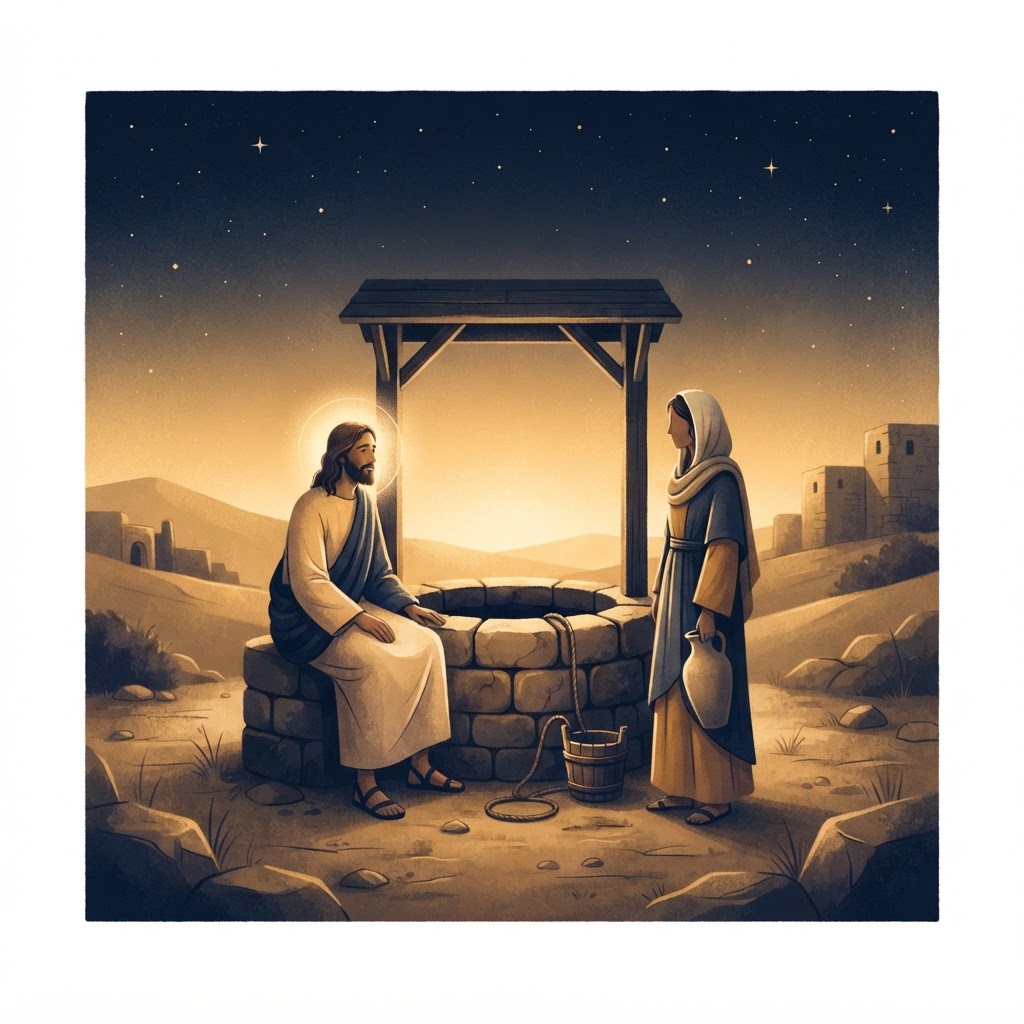
Jesus sat by a well at noon, waiting for a woman with a shattered past. One conversation changed her life — and her entire town.

6 min read
Share

The Biblical Account

John 4 records Jesus' encounter with the Samaritan woman at Sychar. Jesus 'had to pass through Samaria' (4:4) — not geographically (Jews often detoured around Samaria), but divinely. He had a divine appointment. 'Jacob's well was there; so Jesus, wearied as he was from his journey, was sitting beside the well. It was about the sixth hour' (4:6) — noon, the hottest part of the day, when women typically didn't draw water.

A Samaritan woman came to draw water. Jesus said: 'Give me a drink' (4:7). She was startled — 'How is it that you, a Jew, ask for a drink from me, a woman of Samaria?' (4:9). Jews and Samaritans had no dealings with each other. But Jesus was crossing every boundary.

Jesus redirected: 'If you knew the gift of God, and who it is that is saying to you, 'Give me a drink,' you would have asked him, and he would have given you living water' (4:10). She didn't understand: 'Sir, you have nothing to draw water with, and the well is deep. Where do you get that living water?' (4:11).

Jesus pressed deeper: 'Everyone who drinks of this water will be thirsty again, but whoever drinks of the water that I will give him will never be thirsty again. The water that I will give him will become in him a spring of water welling up to eternal life' (4:13-14). She asked for this water — but Jesus turned to her deepest need: 'Go, call your husband, and come here' (4:16). 'I have no husband,' she said. Jesus revealed His knowledge: 'You are right... you have had five husbands, and the one you now have is not your husband' (4:17-18).

The conversation shifted to worship. She asked about the Samaritan temple on Mount Gerizim vs. the Jewish temple in Jerusalem. Jesus declared: 'The hour is coming, and is now here, when the true worshipers will worship the Father in spirit and truth... God is spirit, and those who worship him must worship in spirit and truth' (4:23-24). True worship is not about location but about the heart.

Then she said: 'I know that Messiah is coming (he who is called Christ). When he comes, he will tell us all things' (4:25). Jesus' response: 'I who speak to you am he' (4:26) — one of His clearest messianic declarations.

The woman left her water jar, ran to the city, and told everyone: 'Come, see a man who told me all that I ever did. Can this be the Christ?' (4:29). 'Many Samaritans from that town believed in him because of the woman's testimony' (4:39). One conversation with Jesus changed her life — and her entire community.

The World at That Time

The animosity between Jews and Samaritans was centuries old. After the Assyrian conquest of the Northern Kingdom (722 BC), the Israelites who remained intermarried with foreign settlers, producing the Samaritan people (2 Kings 17:24-41). The Samaritans built their own temple on Mount Gerizim (c. 400 BC), which was destroyed by John Hyrcanus in 128 BC. Jews considered Samaritans ritually impure, religiously heretical, and ethnically compromised.

Jesus' journey through Samaria was itself unusual. Many Jews traveling between Galilee and Judea would cross the Jordan, travel through Perea, and re-cross — adding days to avoid Samaritan territory. Jesus 'had to pass through Samaria' (John 4:4) not by geographic necessity but by divine necessity. He had an appointment.

Jacob's well, mentioned in John 4:6, is still identified at the foot of Mount Gerizim, near modern Nablus. It is one of the few biblical sites whose identification is undisputed. The well is about 100 feet deep, cut through solid rock — 'the well is deep' (4:11).

The woman's noon visit was unusual. Women typically drew water in the cool of morning or evening, and they came in groups. Coming alone at noon suggests she was a social outcast — avoiding the other women's judgment. Her history — five husbands, now living with a sixth man — confirms this. Jesus met her in her shame, at the hour of her isolation.

'Living water' (hydor zon) in Jewish thought referred to flowing water — from a spring or stream, as opposed to still water in a cistern. The prophets used it metaphorically for God's provision and Spirit: 'With joy you will draw water from the wells of salvation' (Isaiah 12:3). 'I will pour water on the thirsty land, and streams on the dry ground; I will pour my Spirit upon your offspring' (Isaiah 44:3). Jesus was claiming to fulfill the prophetic promise — to be the source of the Spirit's living water. 'If anyone thirsts, let him come to me and drink. Whoever believes in me... 'Out of his heart will flow rivers of living water.' Now this he said about the Spirit' (John 7:37-39).

The woman's testimony — 'Come, see a man who told me all that I ever did' (4:29) — is one of the earliest examples of evangelism in the New Testament. She didn't have a theology degree. She didn't have all the answers. She had an encounter with Jesus — and she told people. And 'many believed' (4:39). The harvest Jesus described was beginning: 'Lift up your eyes, and see that the fields are white for harvest' (4:35).

Faith Reflection

The Woman at the Well reveals Jesus as the One who crosses every boundary to reach the broken. He crossed geographic boundaries (Samaria), ethnic boundaries (Samaritan), gender boundaries (a woman alone), moral boundaries (an adulteress), and religious boundaries (a heretic). No one is too far, too broken, or too despised for Jesus to reach.

He also reveals that our deepest thirst is for God. 'Everyone who drinks of this water will be thirsty again' (4:13). The water of this world — success, pleasure, relationships, achievement — never satisfies. We keep coming back to the well, thirsty again. The things we use to fill the God-shaped hole in our hearts are not bad things; they're just not big enough. 'You have made us for yourself, O Lord, and our heart is restless until it rests in you' (Augustine).

But Jesus offers living water. Not a different well — a different kind of water. 'Whoever drinks of the water that I will give him will never be thirsty again' (4:14). This water doesn't just satisfy; it becomes a spring — 'welling up to eternal life.' The Spirit of God, given by Christ, becomes an internal source — a spring that never runs dry. 'Whoever believes in me... Out of his heart will flow rivers of living water' (John 7:38).

Notice Jesus' method. He didn't start with her sin; He started with her thirst. He didn't condemn her lifestyle; He offered her living water. He didn't list her failures; He revealed His identity. He met her where she was — in shame, in isolation, in a life of failed relationships — and offered her what no man could give: eternal satisfaction.

And she responded with testimony. She didn't understand everything. She was still working it out ('Can this be the Christ?'). But she had encountered Jesus, and that was enough. She left her water jar (the very thing she came for) and ran to tell others. When you meet Jesus, your old priorities lose their grip. The water jar of the world is abandoned for the living water of Christ.

Are you thirsty? Jesus is sitting by the well. He has been waiting for you. He knows everything you've ever done — and He loves you anyway. He offers living water — the Spirit, the spring of eternal life. 'If anyone thirsts, let him come to me and drink' (John 7:37).

Scripture Reference

John 4:1-42; Isaiah 12:3, 44:3; John 7:37-39

More in John

“Your word is a lamp to my feet and a light to my path.” — Psalm 119:105