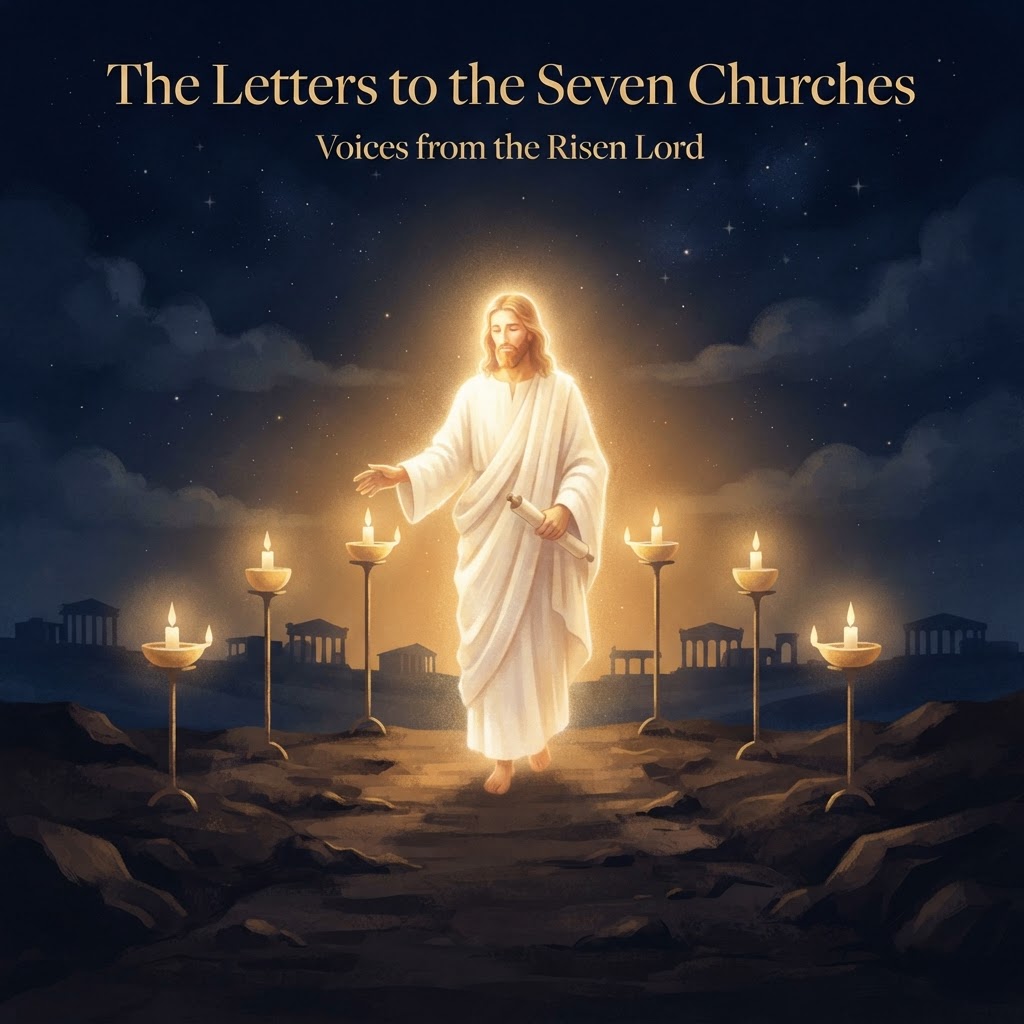
The Letters to the Seven Churches: Voices from the Risen Lord
Revelationc. 95 AD

The Letters to the Seven Churches: Voices from the Risen Lord

The risen Christ dictated seven letters to seven real churches — each with a specific message, a specific warning, and a specific promise. They still speak today.

7 min read
Share

The Biblical Account

Revelation 2-3 contains seven letters from the risen Christ to seven churches in Asia Minor (modern Turkey): Ephesus, Smyrna, Pergamum, Thyatira, Sardis, Philadelphia, and Laodicea. Each letter follows a pattern: a description of Christ, a commendation, a criticism, a command, and a promise 'to the one who conquers.'

**Ephesus** (2:1-7): The hardworking, doctrinally pure church that 'lost the love you had at first' (2:4). Commended for endurance and rejecting false apostles. Criticized for losing its first love. Command: 'Remember... repent... do the works you did at first.' Promise: 'To the one who conquers I will grant to eat of the tree of life.'

**Smyrna** (2:8-11): The suffering church, facing poverty and persecution. No criticism — only encouragement: 'Do not fear what you are about to suffer... Be faithful unto death, and I will give you the crown of life.' Promise: 'The one who conquers will not be hurt by the second death.'

**Pergamum** (2:12-17): The compromising church, holding to faith in a difficult place ('where Satan's throne is') but tolerating false teaching (the teaching of Balaam and the Nicolaitans). Command: 'Repent.' Promise: 'Hidden manna' and 'a white stone with a new name.'

**Thyatira** (2:18-29): The church with growing love and service but tolerating 'Jezebel' — a false prophetess leading people into sexual immorality and idolatry. Command: 'Hold fast... until I come.' Promise: authority over the nations.

**Sardis** (3:1-6): The dead church — 'You have the reputation of being alive, but you are dead.' A few faithful remained. Command: 'Wake up... strengthen what remains... repent.' Promise: 'White garments... I will never blot his name out of the book of life.'

**Philadelphia** (3:7-13): The faithful church with 'little power' but an open door. No criticism. Commended for keeping 'my word and not denying my name.' Promise: 'I will make them come and bow down before your feet' and 'I will keep you from the hour of trial.'

**Laodicea** (3:14-22): The lukewarm church — 'neither hot nor cold.' Rich and self-sufficient: 'I am rich... and need nothing.' But Jesus says: 'You are wretched, pitiable, poor, blind, and naked.' The famous invitation: 'Behold, I stand at the door and knock. If anyone hears my voice and opens the door, I will come in to him and eat with him, and he with me' (3:20). Promise: 'The one who conquers, I will grant him to sit with me on my throne.'

Each letter ends: 'He who has an ear, let him hear what the Spirit says to the churches.' The letters were to real churches — but they speak to every church, in every age.

The World at That Time

The seven churches were real congregations in seven cities of the Roman province of Asia (western Turkey), connected by a circular road. John, exiled on Patmos, received the vision 'on the Lord's day' (Revelation 1:10) and was commanded to write what he saw to these seven churches (1:11). The order follows the postal route: Ephesus → Smyrna → Pergamum → Thyatira → Sardis → Philadelphia → Laodicea.

Each letter's details are tailored to the local context, making the messages vividly relevant:

Ephesus was a major city, home to the Temple of Artemis (Diana). The church was founded by Paul (Acts 19) and later pastored by Timothy and, tradition says, John. 'Lost your first love' (2:4) may refer to declining passion for Christ or for each other.

Smyrna (modern Izmir) was a beautiful city loyal to Rome. The church faced intense persecution from local Jews ('a synagogue of Satan,' 2:9) and was about to face worse. The 'ten days' of tribulation (2:10) may refer to a specific period of intensified persecution. Polycarp, bishop of Smyrna and a disciple of John, was martyred there c. 155 AD.

Pergamum was the political capital of the province, home to temples to Zeus, Athena, and Asclepius (the healing god, whose symbol was a serpent). 'Where Satan's throne is' (2:13) may refer to the altar of Zeus (a massive structure visible from across the city, now in a Berlin museum) or the imperial cult.

Thyatira was a commercial center known for its trade guilds — dyers, coppersmiths, and tanners. Belonging to a guild involved pagan banquets and sexual immorality. 'Jezebel' (2:20) was likely a woman in the church advocating accommodation with guild practices.

Sardis was a once-great city (capital of the Lydian Empire) that had declined. It was captured twice due to overconfidence — its citadel was considered impregnable, but enemies climbed the cliffs at night. 'You have the reputation of being alive, but you are dead' (3:1) and 'if you will not wake up, I will come like a thief' (3:3) echo Sardis's history of being caught off guard.

Philadelphia was a small city in a seismically active region, frequently devastated by earthquakes. 'I will make him a pillar in the temple of my God... never to go out of it' (3:12) would have resonated deeply with people who constantly fled their crumbling city.

Laodicea was a wealthy banking center, famous for medical school (especially eye salve) and black wool. Its lack of a local water supply meant water was piped from hot springs six miles away — arriving lukewarm. 'You are neither hot nor cold... I wish you were either one' (3:15-16) references this. 'I counsel you to buy... white garments... and salve to anoint your eyes' (3:18) addresses Laodicea's famous products — wealth, black wool, eye salve — and says they are spiritually bankrupt.

The letters' details, woven from local geography and history, demonstrate that the risen Christ knows His churches intimately. He sees their works, knows their struggles, and speaks precisely to their condition. 'The One who has the seven stars in his right hand... the One who walks among the seven golden lampstands' (2:1) is present among His people — seeing, knowing, speaking.

Faith Reflection

The seven letters speak to every church — and every believer — in every age. Their themes are timeless: lost love (Ephesus), suffering (Smyrna), compromise (Pergamum), false teaching (Thyatira), dead orthodoxy (Sardis), faithful endurance (Philadelphia), and lukewarm self-sufficiency (Laodicea).

Which one is you?

Are you like Ephesus — doctrinally sound, morally upright, but missing the fire of first love? You do all the right things, but your heart has grown cold. You serve, but you don't adore. Remember. Repent. Do the works you did at first.

Are you like Smyrna — suffering, poor, under pressure? Be faithful. The crown of life awaits. Your poverty is richness. Your suffering is temporary. 'Do not fear what you are about to suffer.'

Are you like Pergamum and Thyatira — holding to faith but tolerating compromise? False teaching has crept in. Worldly practices have been accommodated. Repent. Hold fast. Don't let the world shape the Church.

Are you like Sardis — alive in reputation but dead in reality? You look good from the outside — active, busy, impressive — but there's no life. Wake up. Strengthen what remains. Repent.

Are you like Philadelphia — weak but faithful? You have 'little power' (3:8) but you've kept the word and not denied the name. An open door is before you. Hold on. Christ is coming.

Are you like Laodicea — lukewarm, self-sufficient, needing nothing? You say, 'I am rich.' But Jesus says: you are 'wretched, pitiable, poor, blind, and naked' (3:17). The shocking diagnosis: you don't even know how bad off you are.

But the Laodicean letter ends with one of the most beautiful invitations in Scripture: 'Behold, I stand at the door and knock. If anyone hears my voice and opens the door, I will come in to him and eat with him, and he with me' (3:20). Jesus is not outside the door of the unbeliever's heart — He is outside the door of His own church. The One who walks among the lampstands is knocking on the door of His people, asking to come in.

Open the door. Let Him in. Fellowship with Christ — 'eat with him' — is the promise to the one who conquers. And the promise extends to all seven letters: 'To the one who conquers...' The tree of life. The crown of life. A new name. Authority over nations. White garments. A place in the temple. A seat on His throne.

'He who has an ear, let him hear what the Spirit says to the churches.' Do you have ears to hear? What is the Spirit saying to you?

Scripture Reference

Revelation 2-3; Revelation 1:9-20

More in Revelation

“Your word is a lamp to my feet and a light to my path.” — Psalm 119:105