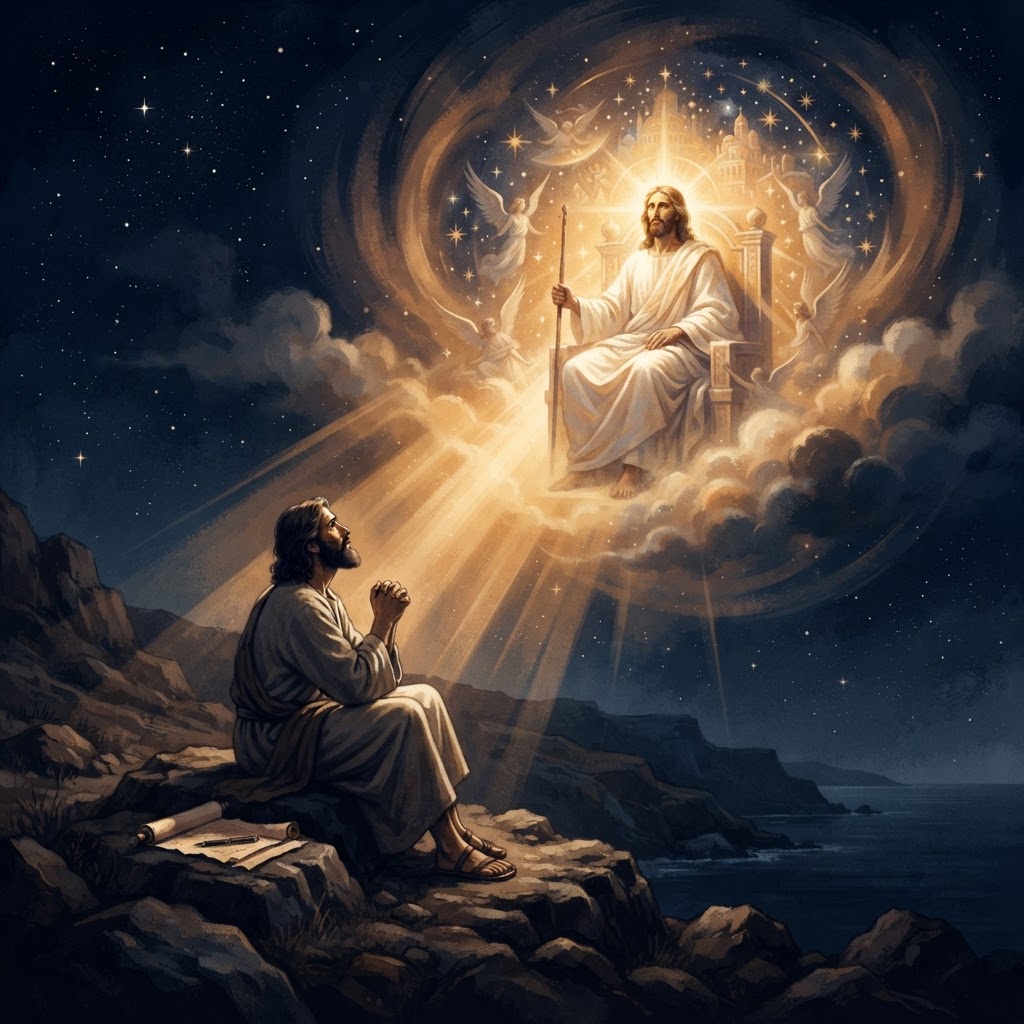
The Final Triumph: John's Vision of Eternity Unveiled
The Book of Revelation: The Unveiling of Christ's Final TriumphFirst Century Roman Empire

The Final Triumph: John's Vision of Eternity Unveiled

Exiled on a desolate island, the Apostle John receives a cosmic vision that pulls back the curtain on the future of humanity. Discover the ultimate hope found in Christ's final victory over death and darkness.

4 min read
Share

The Biblical Account

The Apostle John, the last surviving disciple of Jesus, was living in exile on the rugged island of Patmos when the heavens opened. In a series of vivid, apocalyptic visions, he saw the resurrected Christ standing amidst seven golden lampstands, holding the keys of death and Hades. He was commissioned to write letters to seven churches in Asia Minor, addressing their spiritual fervor and their failings with divine authority.

Following these messages, John was caught up into the heavenly throne room. He witnessed the worship of the Lamb who was slain, the opening of the seven seals, and the unfolding of God’s redemptive plan for the cosmos. The narrative moves from the struggle of the faithful on earth to the majestic victory of the Lamb, who descends in glory to defeat the beast and establish a reign that knows no end.

The vision culminates in the creation of a new heaven and a new earth. John describes the Holy City, the New Jerusalem, descending from God like a bride adorned for her husband. In this final state, there is no more mourning or pain, for the former things have passed away, and God dwells forever among His people in the light of His glory.

The World at That Time

The Book of Revelation was composed in the late first century, likely around 95 AD, during the reign of the Roman Emperor Domitian. Domitian demanded to be addressed as 'Dominus et Deus'—Lord and God—and enforced imperial cult worship that placed the early Christians in grave danger of persecution.

Patmos, where John was exiled, was a rocky, desolate penal colony in the Aegean Sea. To the Roman authorities, John was a nuisance being tucked away to die, but for the early Church, the island became the site of the most significant revelation since the Gospels. Writing to seven specific cities in the province of Asia—such as Ephesus, Smyrna, and Pergamum—John wrote in the apocalyptic genre, a style common to the era that used symbolic imagery to communicate deep truths to a persecuted community.

This context of hostility and fear makes the message of Revelation particularly potent. The believers were surrounded by the propaganda of a global empire that claimed absolute power, yet John’s writing encouraged them to remain steadfast by reminding them that earthly kingdoms are fleeting, and the throne of God is the only ultimate authority.

Faith Reflection

In our own time, we often feel the weight of a world that seems chaotic or contrary to the values of the Gospel. Just as the early Christians faced pressure to bow to the idols of their age, we are constantly invited to seek comfort in temporary things. Revelation reminds us that Christ is already seated on the throne, and His victory is not a distant possibility but an established reality.

May this history stir your heart to look beyond the immediate horizon. When we feel overwhelmed by the news or the trials of life, let us remember that the end of our story has already been written by the Alpha and the Omega. He is with us today, just as He was with John on Patmos, inviting us to endure with hope until the day we see Him face to face.

Scripture Reference

Revelation 1-22

“Your word is a lamp to my feet and a light to my path.” — Psalm 119:105