The Bronze Serpent: Look and Live
Numbersc. 1407 BC

The Bronze Serpent: Look and Live

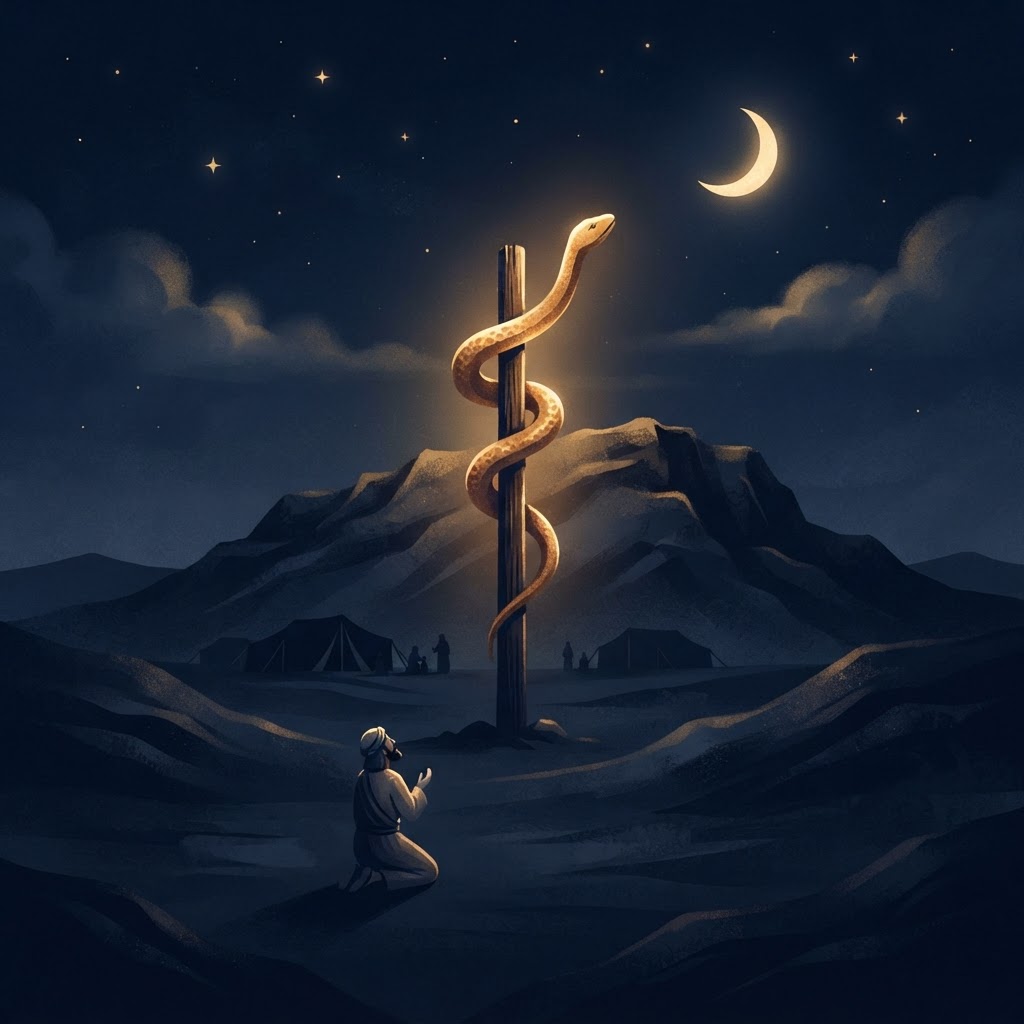
When fiery serpents punished Israel's rebellion, God provided a strange remedy: a bronze serpent lifted on a pole. Whoever looked, lived.

5 min read
Share

The Biblical Account

In Numbers 21:4-9, Israel — once again — complained against God and Moses: 'Why have you brought us up out of Egypt to die in the wilderness? For there is no food and no water, and our soul loathes this worthless food' (21:5). God's response was swift: 'Then the LORD sent fiery serpents among the people, and they bit the people, so that many people of Israel died' (21:6).

The people repented: 'We have sinned, for we have spoken against the LORD and against you. Pray to the LORD, that he take away the serpents from us' (21:7). But God didn't take the serpents away. Instead, He provided a different kind of healing: 'Make a fiery serpent and set it on a pole, and everyone who is bitten, when he sees it, shall live' (21:8). Moses made a bronze serpent, lifted it up, and 'if a serpent bit anyone, he would look at the bronze serpent and live' (21:9).

The remedy was strange. The very thing that caused death — a serpent — became the means of healing. The cure required no medicine, no effort, no merit — just a look of faith. And the look had to be directed at God's provision, not at one's own wound.

Jesus Himself referenced this story: 'And as Moses lifted up the serpent in the wilderness, so must the Son of Man be lifted up, that whoever believes in him may have eternal life' (John 3:14-15). The bronze serpent was a foreshadowing of the cross. As the serpent was lifted up for the dying, Christ was lifted up for sinners. As the bitten Israelites looked and lived, sinners look to Christ and receive eternal life.

The bronze serpent later became an idol (2 Kings 18:4). The Israelites had been burning incense to it — turning a symbol of salvation into an object of worship. Hezekiah destroyed it, calling it 'Nehushtan' ('a piece of bronze'). Even God's provision can become an idol when we worship the symbol instead of the Savior.

The World at That Time

The wilderness journey from Egypt to Canaan should have taken days; it took forty years because of Israel's rebellion. The route from Mount Hor (where Aaron died, Numbers 20:22-29) around Edom to the plains of Moab was a detour — a difficult, hot, and demoralizing march through the Aravah, the rift valley south of the Dead Sea.

The 'fiery serpents' (Hebrew nechashim seraphim) were likely a species of venomous snake native to the region. The word 'fiery' may describe the burning sensation of the venom or the appearance of the snakes. The desert regions of the Aravah and Negev are home to several venomous species, including the saw-scaled viper and the black snake.

In the ancient Near East, serpents were potent symbols — of healing, of wisdom, of chaos, and of death. The caduceus (the staff with serpents) was associated with healing in Greek culture (Asclepius). The symbol may have roots in older Near Eastern traditions. But in Israel's story, the serpent is not an independent power — it is God's instrument, both for judgment and for healing. God sends the serpents; God provides the cure. Both are His.

The bronze serpent was preserved for centuries. By Hezekiah's time (c. 715 BC), it had become an object of idolatrous worship — 'Nehushtan.' This is a warning: even God-given means of grace can become idols. The Israelites began worshipping the bronze serpent instead of the God it pointed to. Hezekiah destroyed it.

Jesus' reference to the bronze serpent (John 3:14-15) transformed its meaning forever. The lifted-up serpent became a type of the lifted-up Christ. The bite of the serpent in Eden brought death; the serpent on a pole brought life. And the Son of Man, lifted up on a cross, brings eternal life to all who look to Him in faith.

Faith Reflection

The bronze serpent is one of the simplest, most beautiful pictures of salvation in all of Scripture. The bitten Israelites didn't have to understand the chemistry of the cure. They didn't have to be worthy of healing. They didn't have to treat their own wounds. They just had to look.

The look was an act of faith. The cure wasn't in the looking; it was in God's promise attached to the bronze serpent. But the look was required. An Israelite lying in his tent, refusing to look, would die — not because the cure wasn't available, but because he wouldn't receive it God's way.

This is the gospel. 'As Moses lifted up the serpent in the wilderness, so must the Son of Man be lifted up, that whoever believes in him may have eternal life' (John 3:14-15). Christ was lifted up — on a cross, for all to see. The venom of sin has bitten us all ('the wages of sin is death'). The cure has been provided. We don't have to understand the theology of the atonement. We don't have to earn it. We don't have to deserve it. We just have to look.

Look at the cross. Look at the Savior. Look and live.

And don't make the mistake of turning the symbol into an idol. The cross is not a lucky charm. The bronze serpent was not magic — it was God's provision, and the power was in God's promise, not in the metal. So it is with Christ. We don't worship the cross; we worship the Christ who was lifted up on it.

'Whoever believes in him may have eternal life.' Look. Believe. Live.

Scripture Reference

Numbers 21:4-9; John 3:14-15; 2 Kings 18:4

More in Numbers

“Your word is a lamp to my feet and a light to my path.” — Psalm 119:105